


There’s a specific kind of frustration that comes from standing in front of a stuffed closet at 7 a.m. and still having nothing to wear. The rod is packed, the shelf is a landslide, and half your wardrobe lives on a chair because the closet gave up months ago.
The closet isn’t the problem, though. The empty air inside it is. Most small closets waste huge amounts of vertical space: the two feet below your shirts, the back of the door, the side walls, the gap above every shelf. These 25 small apartment closet ideas put all of that dead space to work. Most cost under $30, nearly all of them survive a landlord inspection, and a few cost nothing at all.
1. Add a Second Hanging Rod
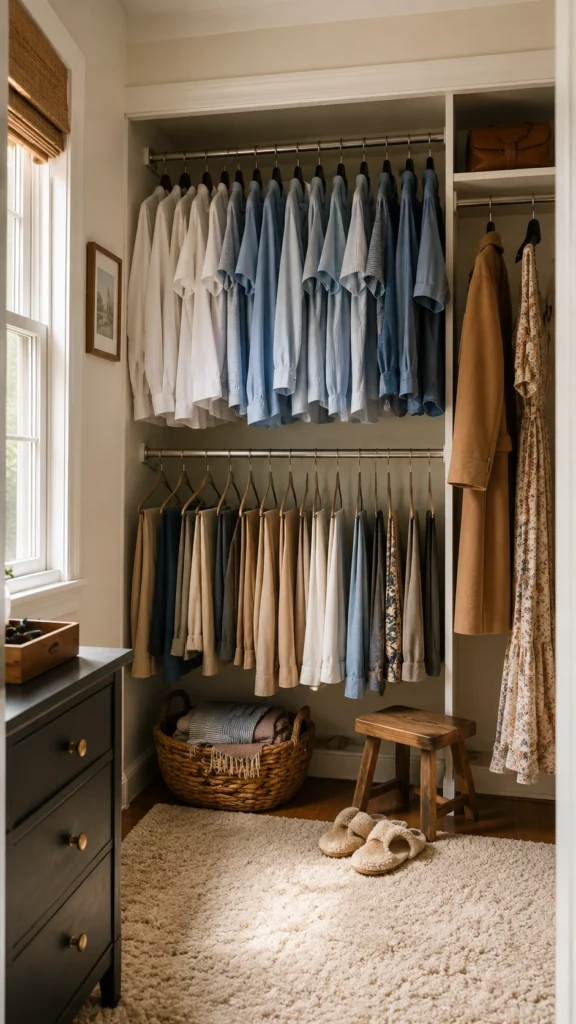
If I had to pick a single upgrade for someone with one high rod and nothing underneath, this would be it. A clip-on doubler rod hangs from your existing rod, needs no tools, and takes about two minutes to install. Shirts, skirts, and folded-over pants all fit fine on the lower level, and your hanging capacity effectively doubles.
Most doublers adjust in both width and height, so you can set the lower bar exactly where your longest shirts end. Just keep one section of the closet single-height for dresses and coats, or they’ll drag on the new rod.
2. Swap Every Hanger for Slim Velvet Ones
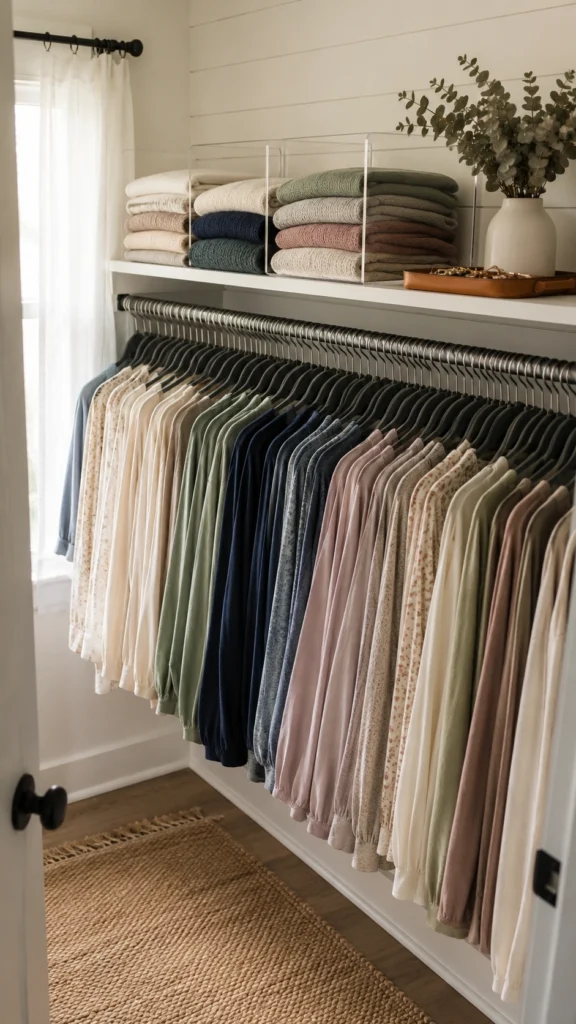
Chunky plastic hangers steal rod space one centimeter at a time. Slim velvet hangers measure about a quarter-inch thick, so a rod that held 30 items now holds 50 to 60. The velvet grip also stops silky tops from sliding onto the floor, which quietly solves the mystery pile at the bottom of the closet.
One thing people often get wrong: replacing hangers gradually. Do it all at once. A 50-pack runs $12 to $18, and mixed hanger types waste the space savings while making the rod look chaotic. Matching hangers make even a full closet read as organized.
3. Hang an Over-the-Door Shoe Organizer
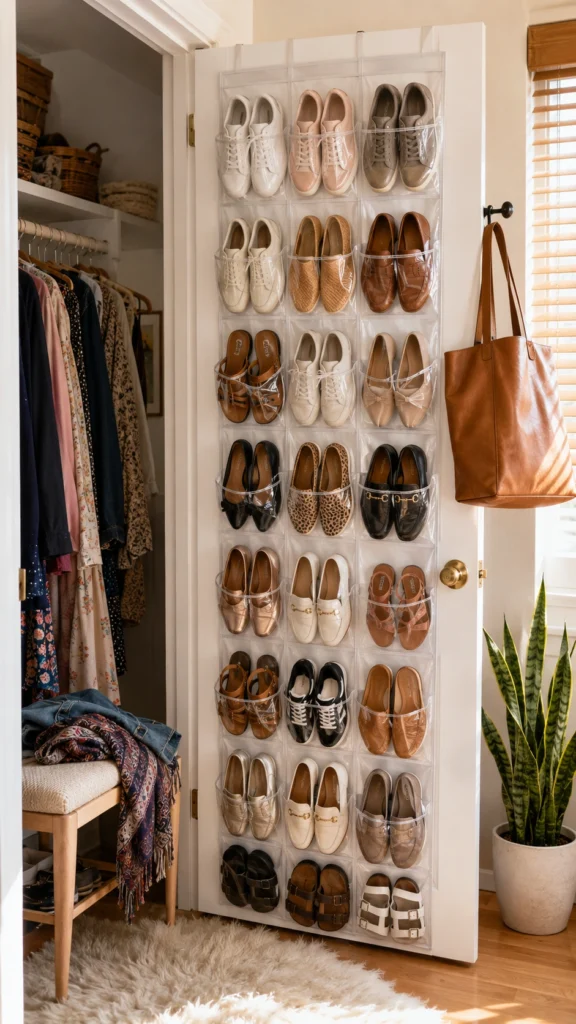
The back of your closet door is storage most people never touch. A pocket organizer holds 20 to 24 pairs of shoes vertically, off the floor, with every pair visible. Clear pockets beat fabric ones, since you can spot the right shoes without opening anything.
Two caveats. Check that the door still clears the frame once the organizer is loaded, because a full one adds surprising bulk. And if shoes aren’t your problem, the same pockets work for rolled leggings, workout gear, or cleaning supplies.
4. Chain Your Pants on Cascading Hangers
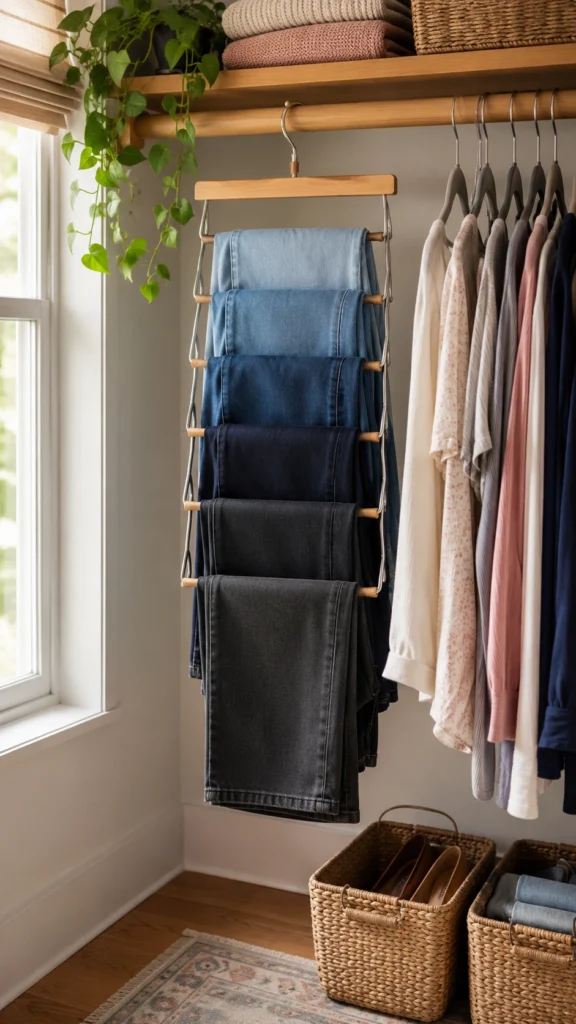
Cascading hangers link five pairs of pants vertically from a single hook, so five pairs of jeans occupy the rod space of one shirt. In a closet where every inch of rod matters, that’s a serious trade.
The catch is weight. Five pairs of denim on one hook concentrates a lot of load in one spot, and cheap tension-style rods sometimes sag or drop under it. Check what your rod can handle before you stack all five.
5. Stop the Sweater Avalanche with Shelf Dividers
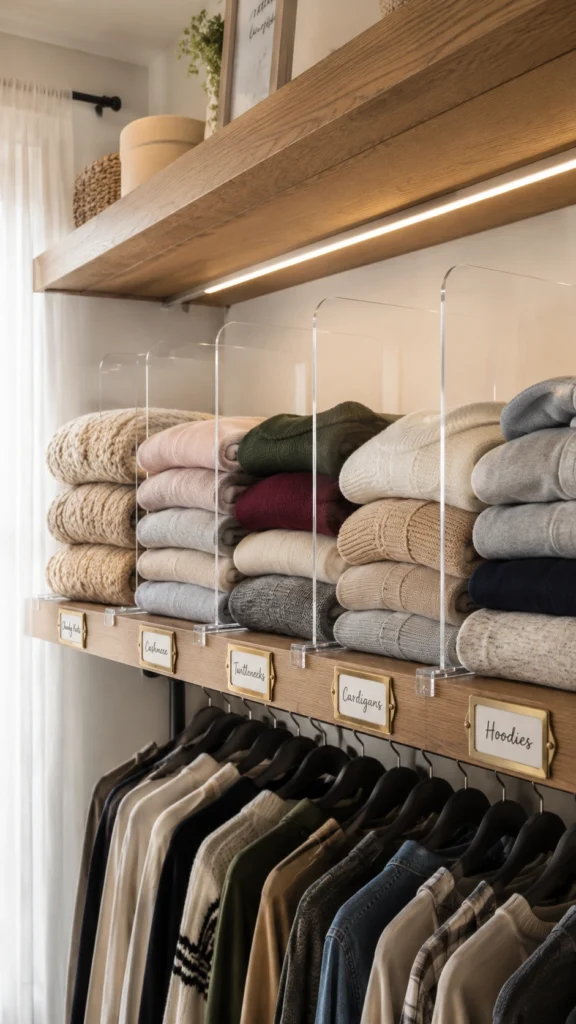
Folded stacks lean, topple, and merge into one sad mound by Friday. That’s just physics; fabric has no structure. Clear acrylic shelf dividers clip onto the shelf edge and hold each stack upright in its own lane, one category per lane.
They work best on wide built-in shelves, the kind that currently hold one giant clothing landslide. You’ll also notice something useful after a week or two: when a stack starts outgrowing its lane, that’s usually the category you own too much of.
6. Banish Seasonal Clothes to Top-Shelf Bins
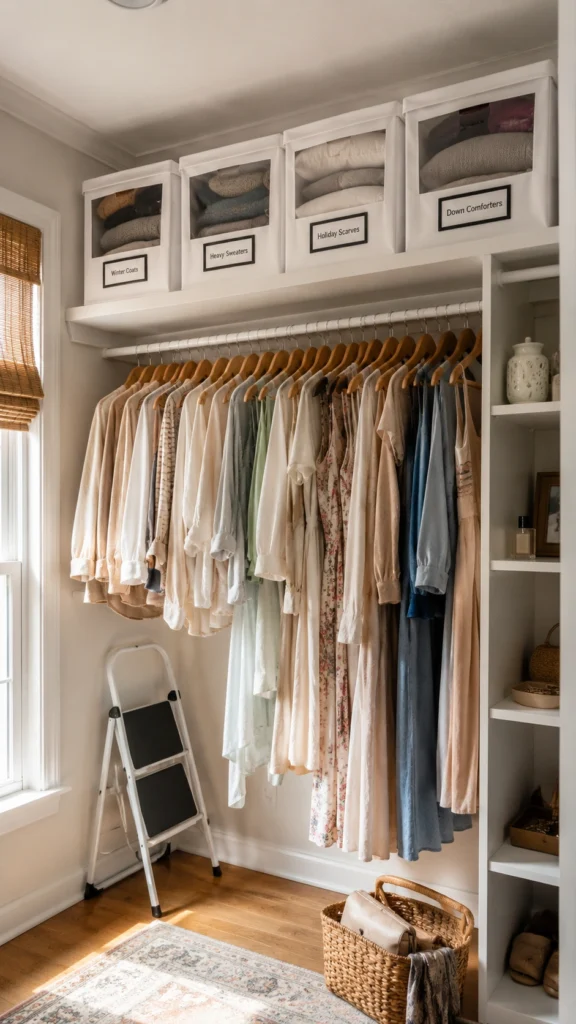
Why does a winter parka get prime closet space in July? Move off-season items into matching lidded bins on the highest shelf and label the front of each bin so you can read it from the floor. Your daily closet shrinks by roughly 40 percent, and everything left actually gets worn.
The swap takes about an hour twice a year. Uniform bin sizes matter more than you’d think here; mismatched containers make the top shelf look like a storage unit auction.
7. Hang a Fabric Shelf Organizer from the Rod
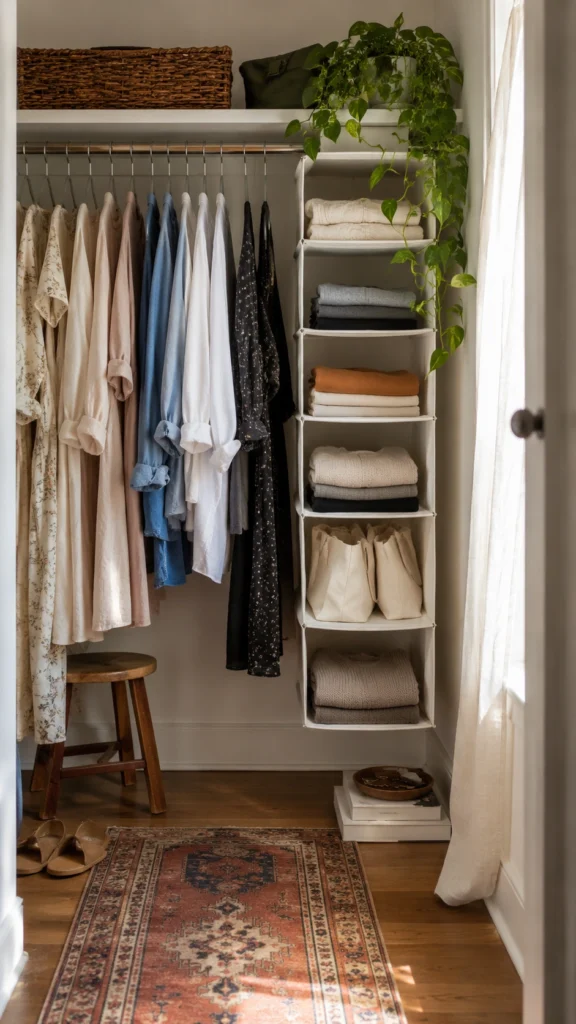
No shelves at all? A hanging fabric organizer loops over the rod and gives you five or six instant cubbies for folded tees, sweaters, or bags. It costs around $15, installs in ten seconds, and moves out with you on lease day. For closets that are literally a rod and four walls, this is the cheapest shelving that exists.
It does eat some rod space, so hang it at one end rather than the middle.
8. Mount Adhesive Hooks on the Side Walls
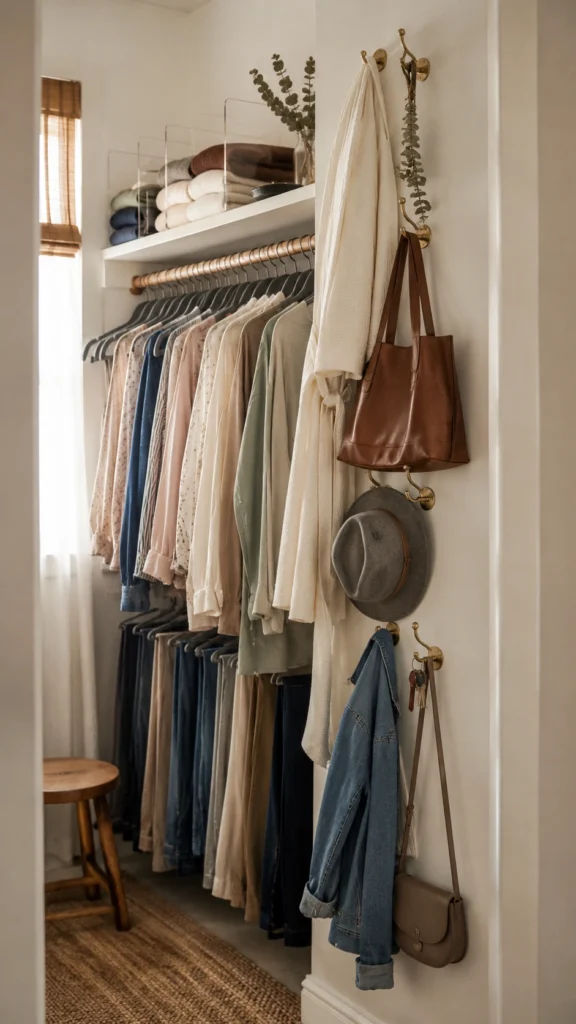
The narrow walls inside your closet are doing nothing right now. A column of removable adhesive hooks on each side wall handles robes, belts, tote bags, or tomorrow’s outfit. Heavy-duty versions hold up to 7.5 pounds and peel off without wrecking the paint, which makes them one of the few storage upgrades a strict landlord can’t object to.
Personally, I’d dedicate one hook near the door to the next day’s outfit. It’s a small habit that shaves real time off rushed mornings.
9. Slide a Rolling Cart into the Dead Corner
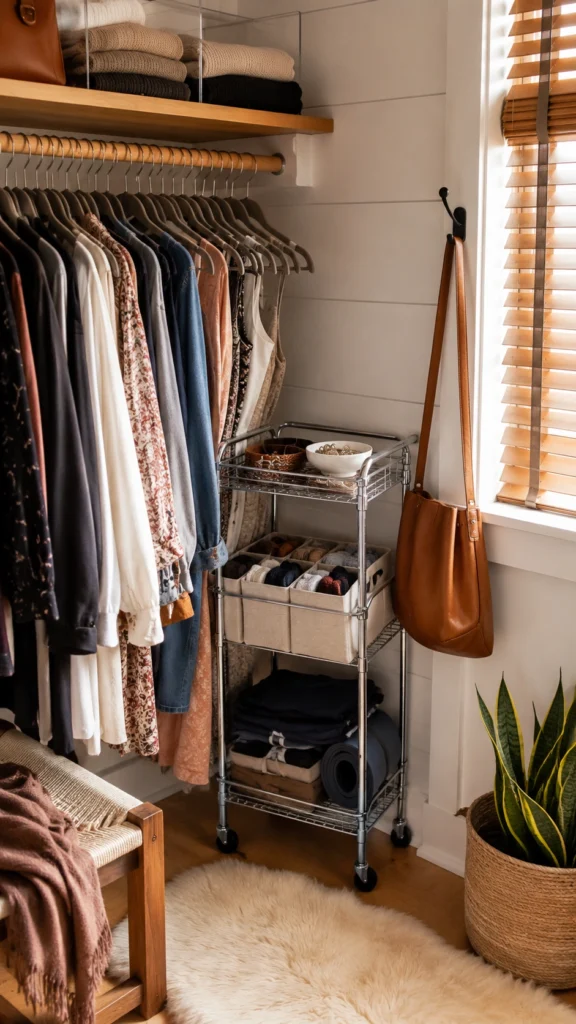
Every closet has an awkward corner where nothing fits. A slim three-tier rolling cart, about 15 inches wide, turns that corner into storage for socks, underwear, accessories, or gym clothes. Roll it out when you need it, tuck it back when you don’t.
Measure the corner before you buy. A cart that blocks your hanging clothes just relocates the problem.
10. Add a Tension Rod Wherever You Need One
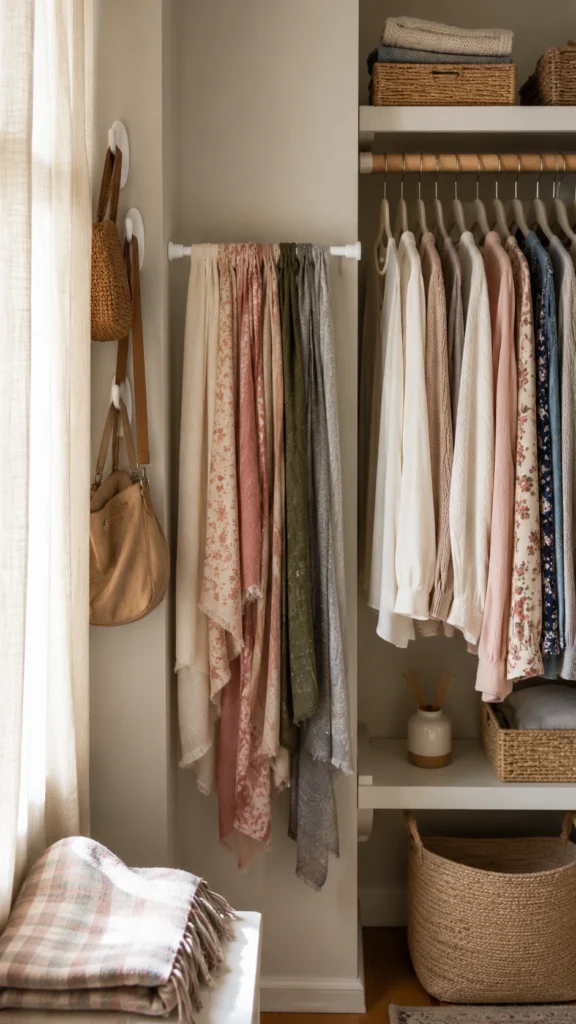
Tension rods might be the most versatile $10 item in home storage. They wedge between two walls with no hardware: mount one low for kids’ clothes, run one across a corner for scarves, or set one vertically between shelves as a divider.
The failure mode is predictable. Someone hangs winter coats on a light-duty rod, and the whole thing crashes down at 2 a.m. Check the weight rating, and save the heavy stuff for the real rod.
11. Clip Under-Shelf Baskets to Existing Shelves
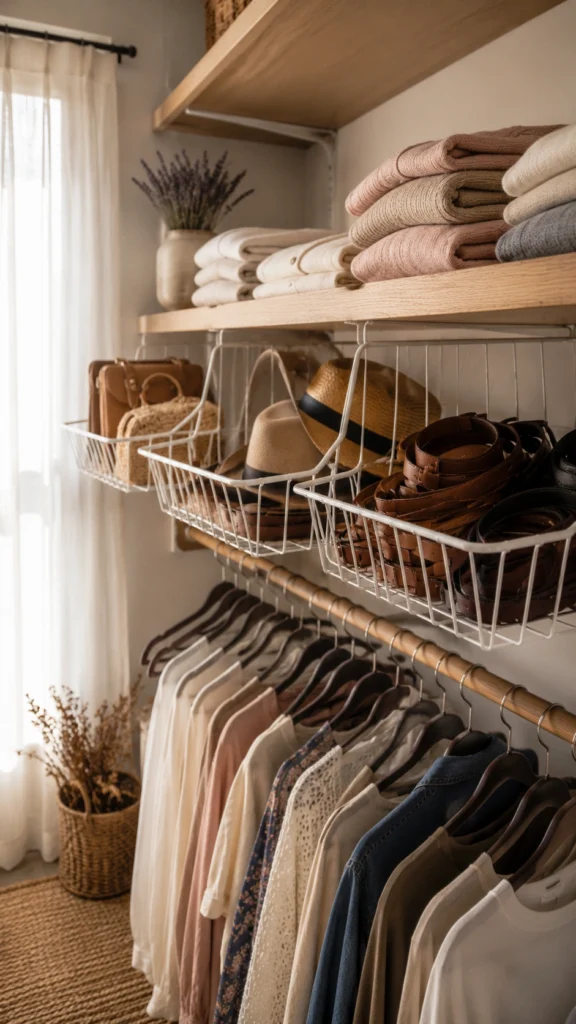
Look at the gap between a folded stack and the shelf above it. That air is storage nobody claimed. Wire under-shelf baskets slide onto the shelf edge and create a bonus layer underneath for clutches, hats, or folded jeans. No tools, no damage, about $10 each.
They’re especially useful in closets with one or two fixed shelves you can’t reposition, which describes most rental closets built before 2000.
12. File-Fold Everything Instead of Stacking
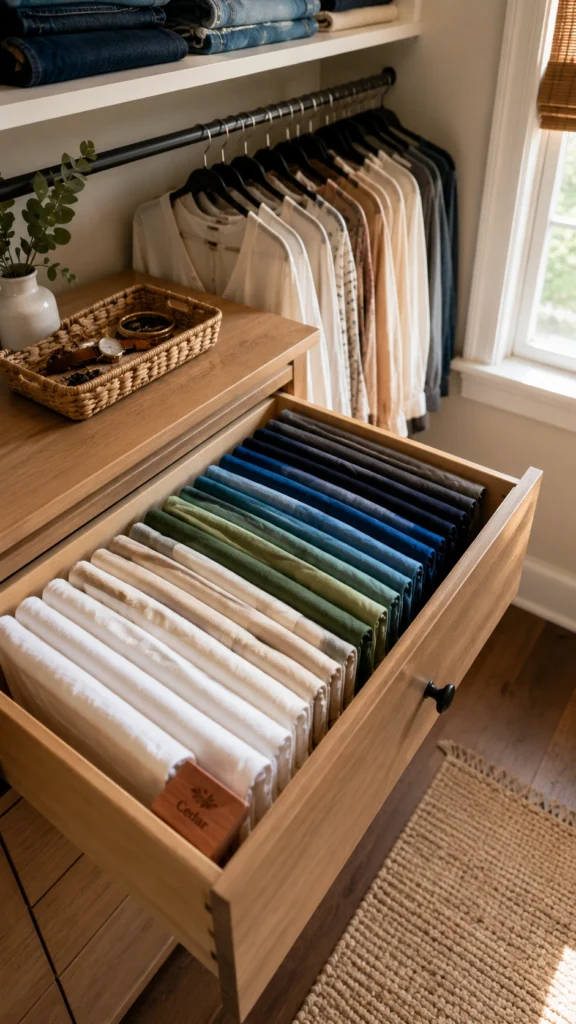
Stacked shirts hide everything below the top one, which is why you wear the same five things on rotation. File folding stores clothes vertically, like folders in a drawer, so every item is visible at a glance. The same drawer holds roughly 30 percent more, and pulling one shirt no longer wrecks the pile.
Most people who try it report the same arc: the first drawer feels fussy, and by the third it’s automatic. Start with t-shirts, since they’re the most forgiving fabric to practice on. The technique carries over to closet bins and suitcase packing too.
13. Double Shoe Capacity with Shoe Slot Stackers
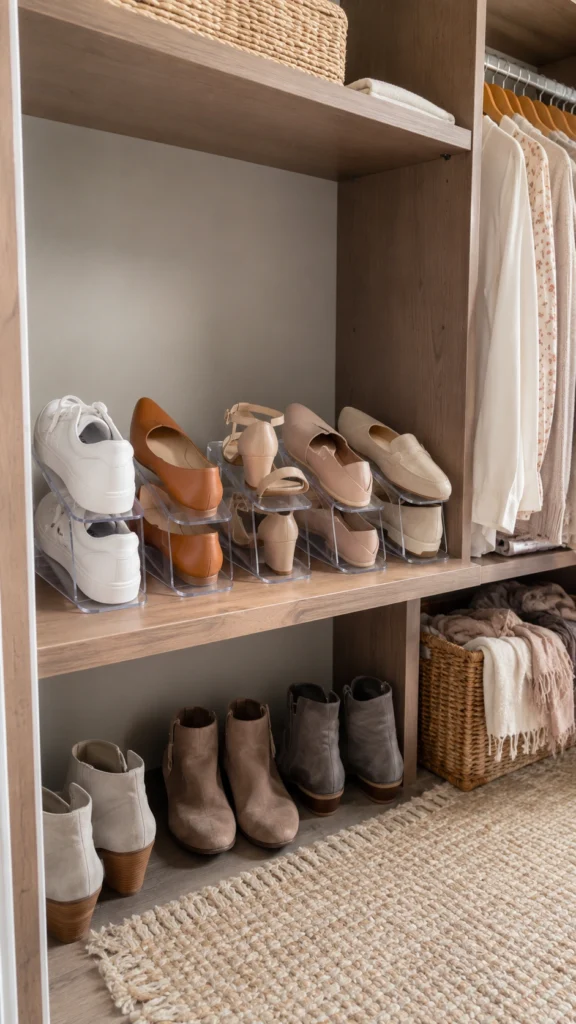
Shoe slots are angled plastic risers that park one shoe on top of its partner, cutting each pair’s footprint in half. For 12 pairs, that’s an entire extra shelf you invented for about $20.
They suit flats, sneakers, and heels. Boots and high-tops won’t cooperate, so plan on a different solution for those (idea 15 covers it).
14. Store Rarely Worn Shoes in Clear Stackable Boxes
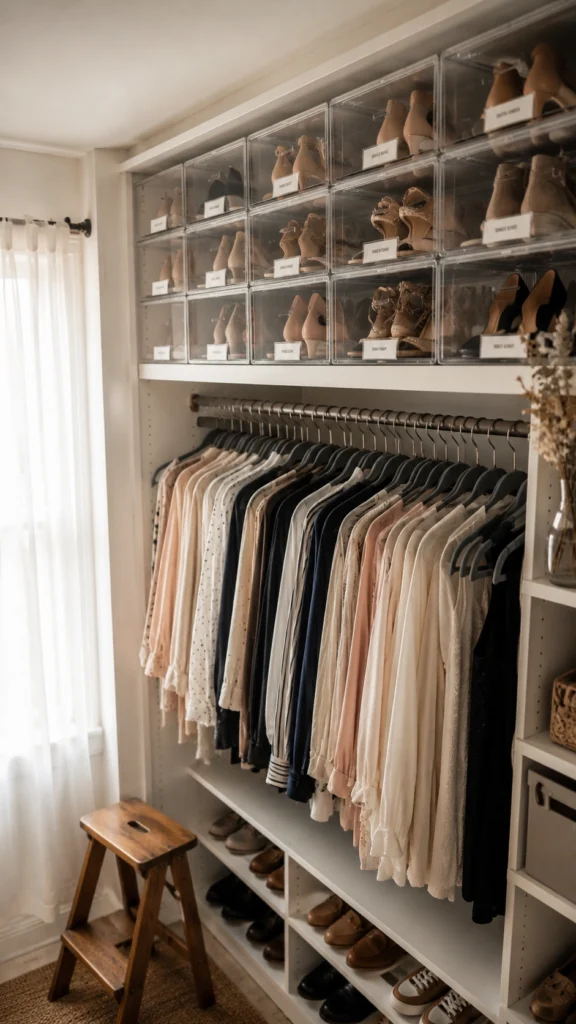
Wedding heels don’t need daily-access space. Clear stackable boxes protect occasional shoes from dust and stack safely to the ceiling of a shelf. Because you can see through them, finding the right pair takes seconds instead of opening five mystery containers.
Face the boxes with toes pointing out. It sounds cosmetic, but a wall of visible shoes reads as intentional, and you’ll actually remember what you own.
15. Hang Your Boots Instead of Slouching Them
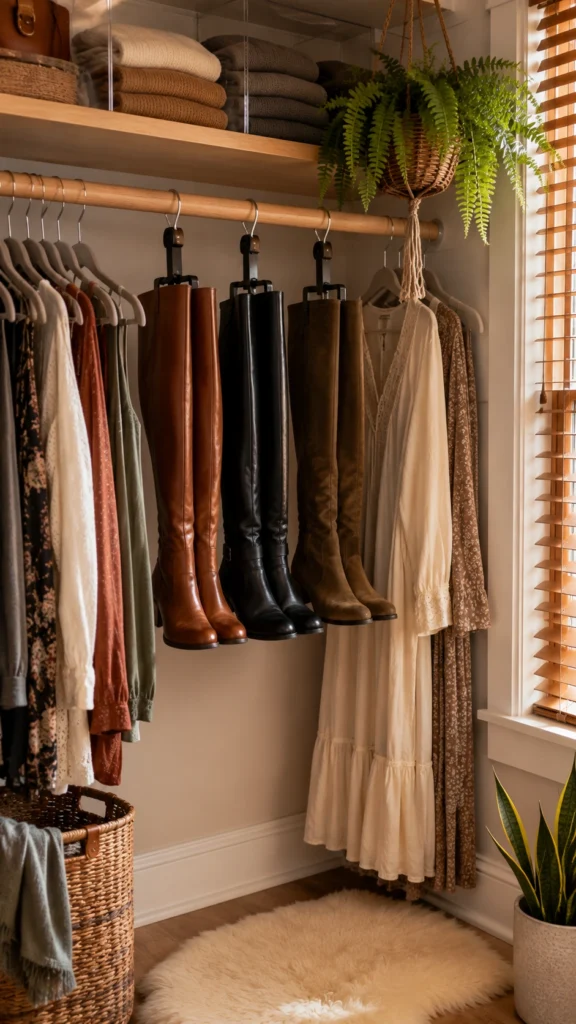
Tall boots flop over, crease at the ankle, and eat a huge patch of floor. Boot clips or clamp-style pant hangers hold them upright from the rod, usually in the same section as your long dresses, since that area already has the vertical clearance. The boots keep their shape, and the floor goes back to your shoe rack.
No budget for clips? A rolled magazine inside each boot does the shape-keeping part for free; you just lose the floor space.
16. Fold Heavy Sweaters, Never Hang Them
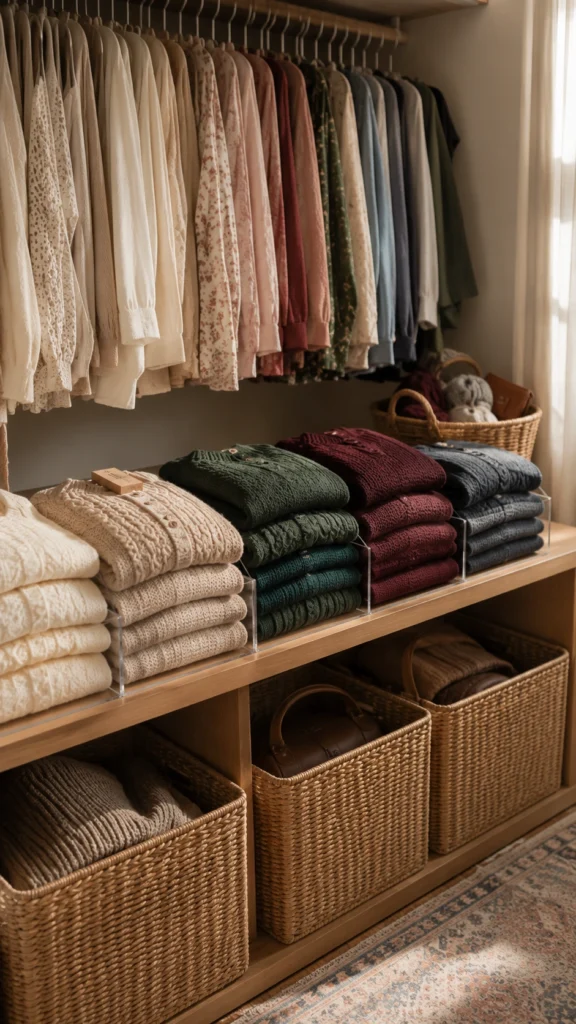
Hangers stretch knit shoulders into pointy bumps that never fully recover, and a thick sweater hogs three shirts’ worth of rod space. Folding solves both problems at once.
The rule of thumb that settles every “hang or fold” debate:
- Hang: shirts, blouses, dresses, blazers, slippery fabrics
- Fold: sweaters, jeans, hoodies, activewear, t-shirts
Hang what wrinkles, fold what stretches. There are edge cases (a structured knit blazer can go either way), but this covers 95 percent of a normal wardrobe.
17. Vacuum-Seal Bulky Bedding and Puffer Coats
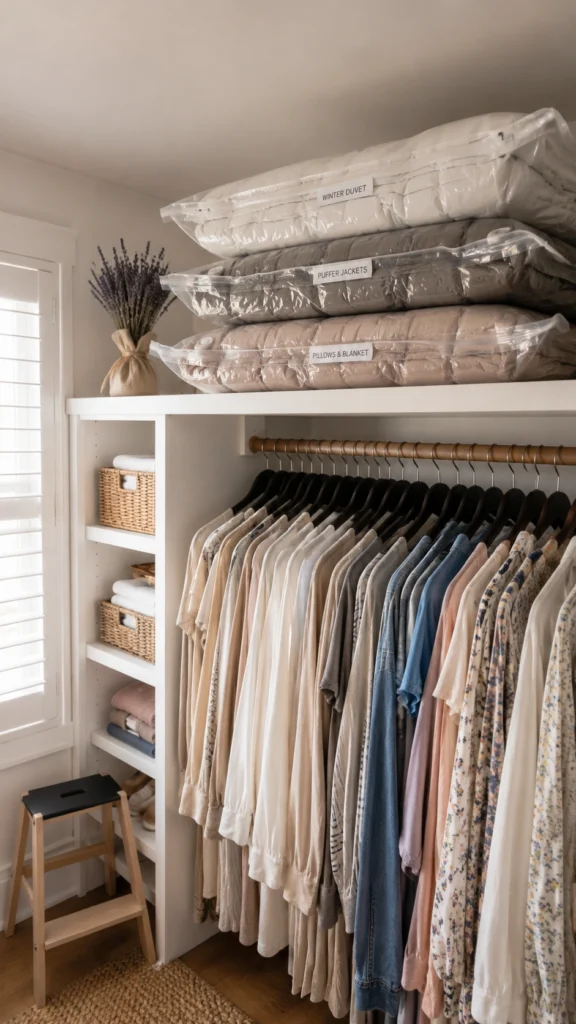
A winter duvet compresses to about a fifth of its size in a vacuum bag, and puffer jackets and spare pillows shrink almost as dramatically. Seal the off-season bulk and slide the flat bags onto the top shelf or under the bed.
One exception worth knowing: don’t leave wool or down compressed for a full year. Those fibers need to breathe occasionally to keep their loft, so open the bags for a day every few months.
18. Put a Slim Dresser Inside the Closet
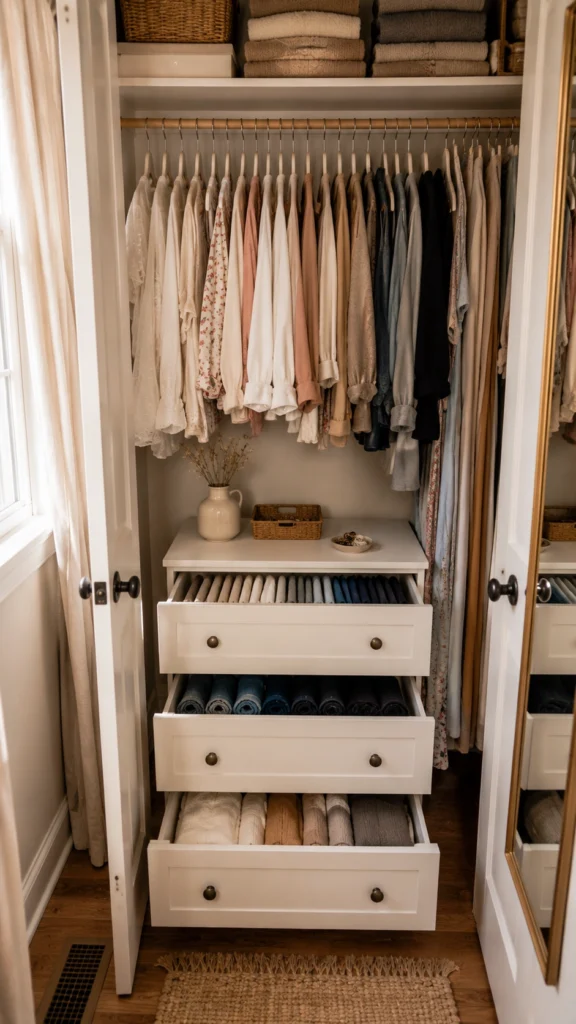
Here’s an underrated move: if your closet has floor space under short hanging clothes, a narrow three-drawer unit fits right in. You gain drawer storage without surrendering any bedroom floor, and the closet door hides the whole thing. In any apartment under 500 square feet, this arrangement usually beats a freestanding bedroom dresser.
It requires a reach-in closet at least 20 inches deep with a single high rod, so measure before you commit.
19. Stick Battery LED Lights Inside
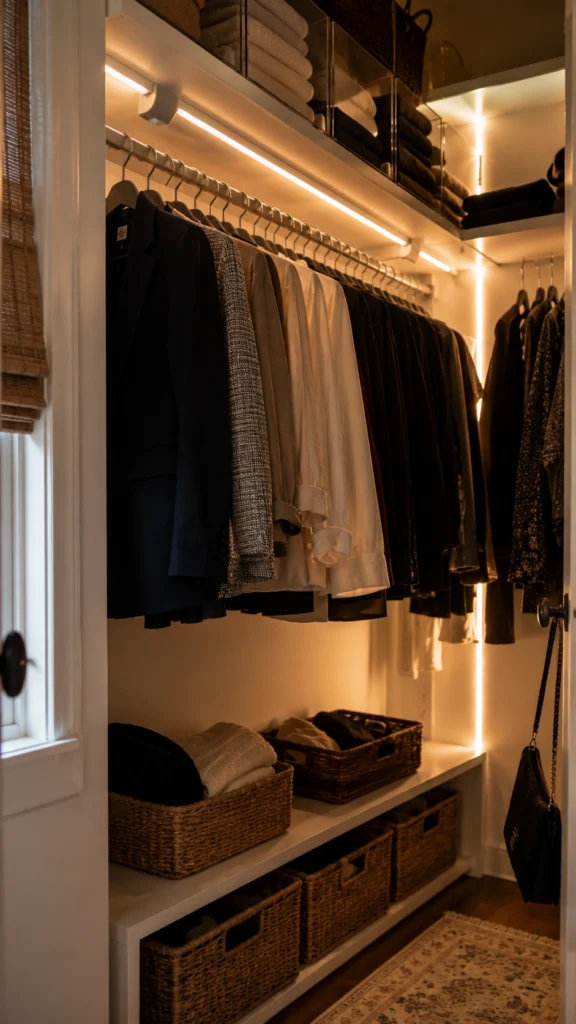
You can’t wear what you can’t see, and most closets are dark caves past the first foot. Motion-activated LED strips or puck lights stick anywhere, need no wiring, and bring the back half of your closet back into circulation. People who add them tend to rediscover clothes they’d mentally written off.
Choose warm white, around 3000K. Cold blue light distorts colors and makes every outfit look slightly wrong before you’ve even left the house.
20. Corral Bags and Hats with S-Hooks
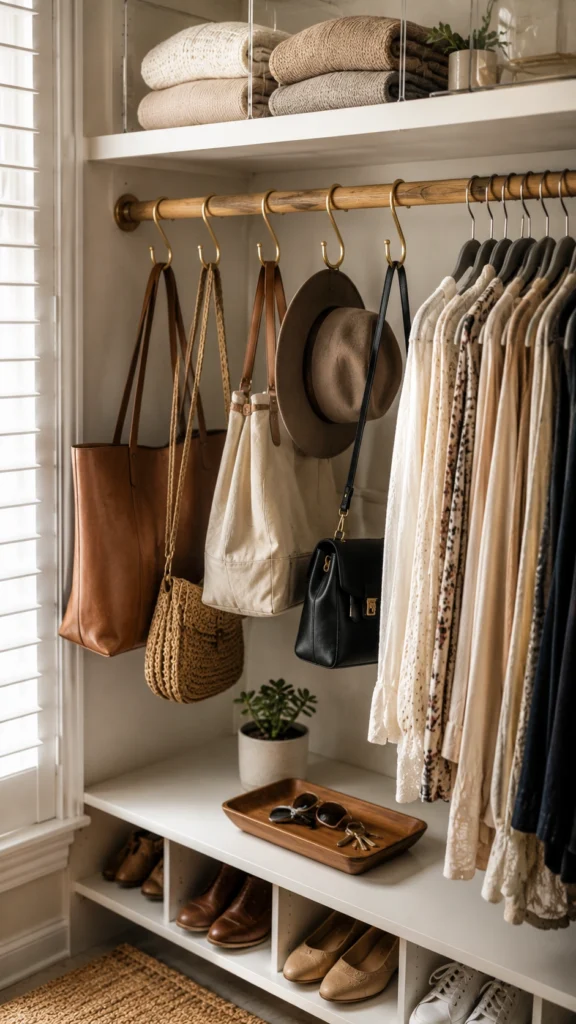
S-hooks loop over the closet rod and hang purses, caps, and totes in the dead air between hanging sections. A pack of ten costs about $8, and your bags stay visible and shaped instead of squashed in a floor pile.
Group them at one end of the rod. Scattered hooks break up the line of hanging clothes and make the whole closet look busier than it is.
21. Hang a Clear Pocket Organizer for Jewelry and Small Stuff
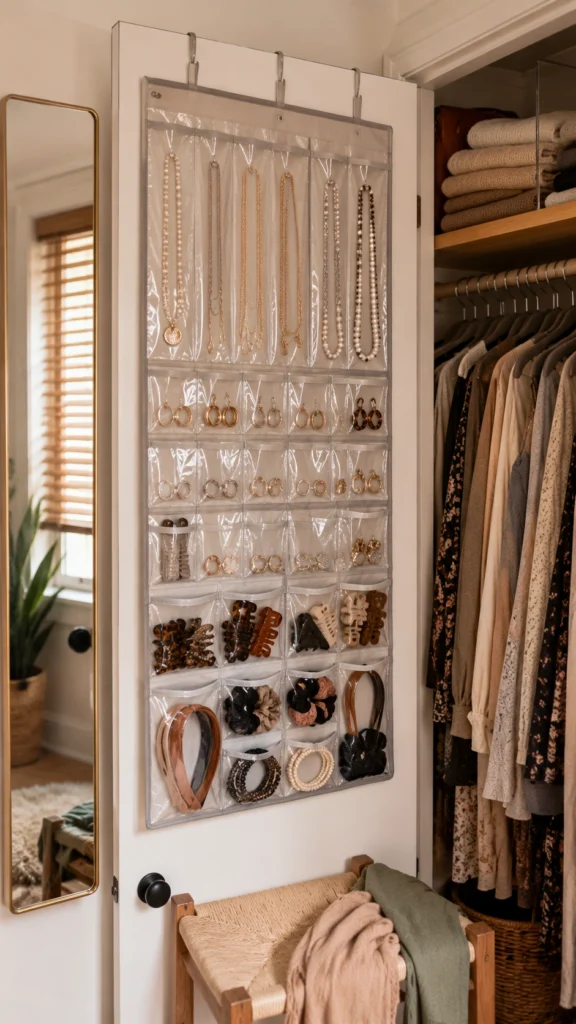
Necklaces tangle, earrings vanish, and hair claws multiply in the dark. A hanging organizer with clear pockets, hooked over the rod or the door, gives every small item a visible slot. Getting ready speeds up because nothing hides.
If you own more than ten pieces of jewelry and zero drawer space, this solves a problem no rod-and-shelf setup ever will.
22. Sort by Category First, Then by Color

Arrange the rod in this order: tanks, short sleeves, long sleeves, jackets, pants, dresses. Then run each category light to dark. Your brain finds “black long-sleeve” in two seconds when the rod follows a pattern, and every item has an obvious home to return to.
This costs nothing and works at any closet size, which is exactly why professional organizers use it on almost every job. A side benefit shows up within a week: a color-ordered rod exposes where your wardrobe repeats itself, which saves you from buying a seventh navy tee.
23. Keep a Donation Bin on the Closet Floor
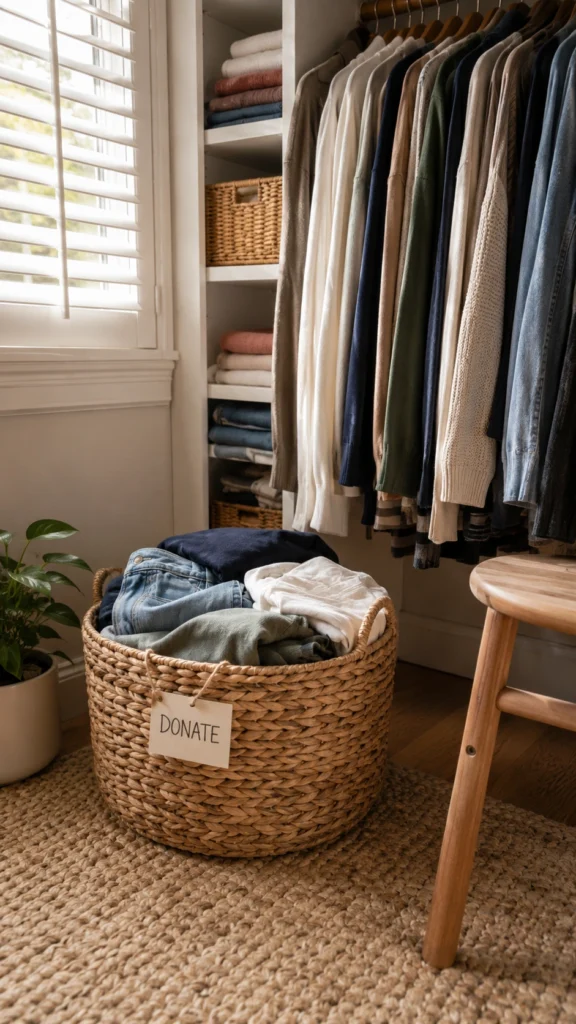
Park a small basket in the corner of the closet. Every time you try something on and think “nope,” it goes straight in the bin instead of back on the rod. When the bin fills, it goes to a donation center.
The genius of this one is that it removes the decluttering “event” entirely. The closet declutters itself continuously, one honest moment at a time, with no scheduled weekend purge.
24. Follow the One-In-One-Out Rule
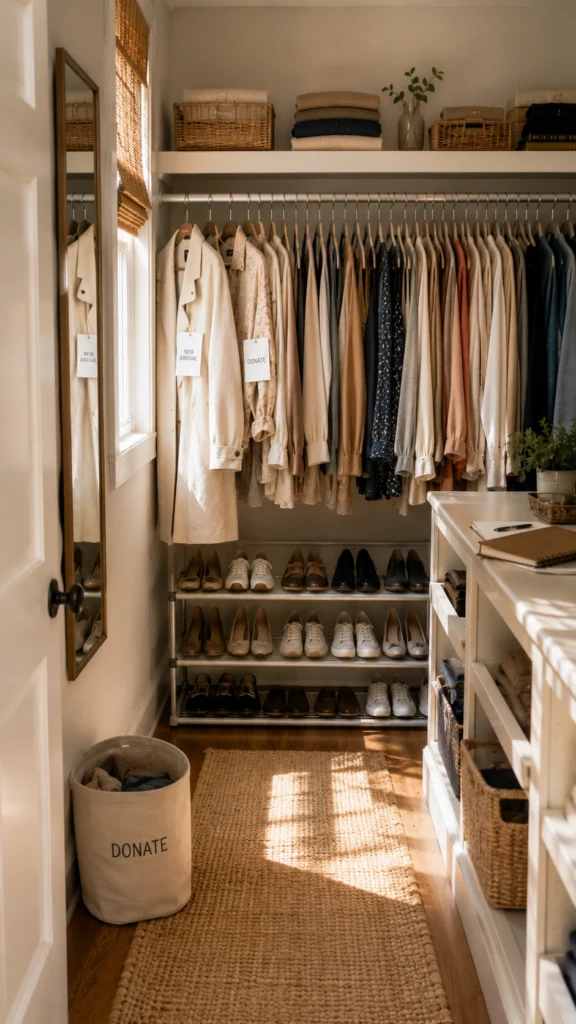
Small closets rarely fail because of bad organizers. They fail because stuff keeps arriving and nothing leaves. The fix is a standing rule: every new item pushes an existing one out.
- Buy a jacket → donate a jacket
- Buy sneakers → toss the dead pair
- Gift sweater arrives → one sweater exits
Your closet volume stays flat, and every other system on this list keeps working instead of slowly drowning. It’s the least glamorous idea here and probably the most important one.
25. Treat Under-Bed Storage as Closet Overflow
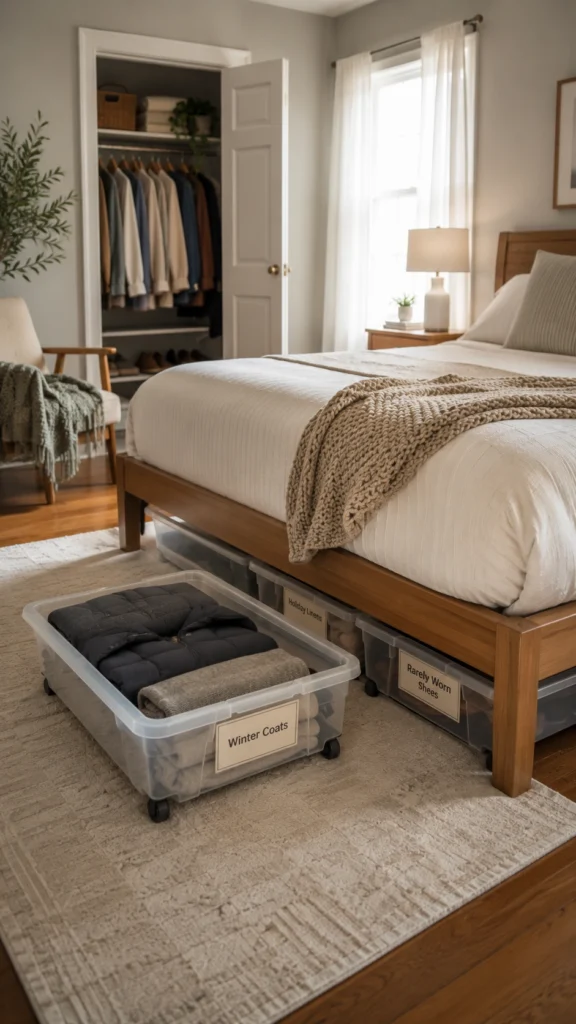
Your closet doesn’t have to hold everything alone. Low rolling bins or zippered bags under the bed handle off-season clothes, extra linens, and rarely worn shoes; the closet keeps only what’s in current rotation, and the two swap contents twice a year.
This assumes at least six inches of clearance under the bed. If yours sits lower, bed risers add the height for about $15, though very low platform beds are out of luck.
Small Closet Mistakes That Undo All Your Work
Before spending anything on organizers, dodge the traps that sink most closet makeovers:
- Organizing before decluttering. Empty the whole closet first. Most people discover 20 to 30 percent of the contents don’t belong there, and every system works better on less stuff.
- Buying bins before measuring. A bin one inch too tall for your shelf becomes floor clutter with a lid. Measure width, depth, and height before you shop.
- Blocking the stuff you use daily. Everyday clothes belong between eye level and hip level. Rarely used items go up high or down low, never the reverse.
- Adding storage instead of removing volume. More organizers holding clothes you never wear is just tidier hoarding.
- Building a system too fussy to maintain. If putting a shirt away takes four steps, you’ll quit within a week. Simple beats clever every time.
How to Pick the Right Small Apartment Closet Ideas for Your Setup
Twenty-five options is a lot. Start with your biggest daily annoyance and work backward from there.
Small Apartment Closet Ideas for Renters
Stick to anything tension-mounted, clip-on, adhesive, or freestanding: the doubler rod, over-door organizer, hanging shelves, adhesive hooks, and rolling cart. Everything moves to the next apartment, and your deposit survives. Skip wall anchors unless your lease explicitly allows them, and favor adjustable pieces you can reconfigure around your next closet’s inevitable quirks.
Small Apartment Closet Ideas on a Tight Budget
Start with what’s free: category-and-color sorting, file folding, the hang-versus-fold rule, and one-in-one-out. Those four alone fix more than most people expect. When you do spend, put the first $25 into velvet hangers, since no other purchase frees up more rod space per dollar.
Small Apartment Closet Ideas for Shared Closets
Mark the rod’s center with a divider clip, give each person a wall of hooks, and assign different colored bins per person. Clear zones prevent most “that’s my shelf” arguments before they start. If one person owns twice the wardrobe, split by volume rather than down the middle, and let the lighter packer claim the under-bed overflow as compensation.
Final Thoughts
The lesson running through all 25 ideas is the same: small closets fail vertically, not horizontally. The air under your shirts, the back of the door, the side walls, and the gap above every shelf together hold more than the rod does, and none of it requires a drill or a landlord’s blessing to claim.
Resist the urge to attempt everything this weekend. Pick two. For most closets, the doubler rod and slim velvet hangers deliver the biggest immediate difference, and both take under an hour combined. Once those feel normal, layer in the next idea. The best closet isn’t the most elaborate one; it’s the one so simple that putting things back never feels like work.
FREQUENTLY ASKED QUESTIONS
How do I organize a small apartment closet with no shelves?
Build shelving that hangs instead of mounts. A fabric shelf organizer loops over the rod and gives you five or six cubbies in ten seconds, a freestanding shoe rack or slim dresser handles the floor, and an over-the-door pocket organizer takes care of small items. You end up with a fully layered closet without drilling a single hole, which matters if you rent.
What’s the cheapest way to make a small closet hold more?
Start with the free changes: sort the rod by category and color, file-fold your drawers, and fold sweaters instead of hanging them. Those three alone recover a surprising amount of space. Your first actual purchase should be slim velvet hangers, since a $15 pack can raise rod capacity from around 30 items to 50 or more. Nothing else on the market returns that much space per dollar.
How can I make a small closet look bigger without renovating?
Visual uniformity does most of the work. Matching hangers, same-size bins, and a clear floor make a packed closet read as calm instead of crowded. Add a battery-powered LED light in warm white, since a dark closet always feels smaller than it is. A mirror on or near the door helps too by bouncing light into the space.
Are closet organizers worth it for renters?
The freestanding and clip-on ones are, because they move with you. Doubler rods, tension rods, over-door organizers, adhesive hooks, and rolling carts all install without tools and leave no trace at move-out. Skip anything requiring wall anchors unless your lease allows it; a $40 mounted system isn’t worth losing part of a deposit over.
How do I keep a small closet organized long-term?
Habits beat products here. A donation bin on the closet floor catches rejects the moment you try them on, the one-in-one-out rule keeps total volume flat, and a twice-yearly seasonal swap moves off-season clothes into top-shelf bins or under the bed. If your setup requires more discipline than that, it’s too complicated and will collapse within a month. Simple systems are the only ones people actually maintain.


Pingback: 25 Brilliant Ways to Organize a Small Apartment and Save Space - Caliora Living