
The porch is done. The mantel got its makeover two weekends ago. And the living room, the one room you actually sit in during October, still looks like it’s waiting for summer to finish.
Which is backwards, because October happens in there. Movie nights, the candy bowl that keeps mysteriously emptying, the annual disagreement over whether “Hocus Pocus” counts as horror. One pumpkin on the coffee table doesn’t cover it.
What follows is 35 Halloween living room decor ideas with real quantities, rough costs, and setup times attached, because “add some pumpkins” has never helped anybody. Renters get options that leave the walls untouched. If you have no fireplace, there’s a section for you. Pick four or five that suit your space, ignore the rest, and a weekend handles the whole room.
How to Choose Halloween Living Room Decor Ideas That Actually Work
Pick Your Palette Before You Buy Anything
Most decorating regret starts in the store aisle, not at home. A purple garland here, an orange pillow there, a black gothic skull because it was on sale, and once it all lands on the couch, nothing agrees with anything else. Choose one of these five palettes and shop only inside it:
- Warm neutral: cream, oat, matte black. Anchor props: boucle pumpkins, one ghost figurine.
- Classic orange and black: the nostalgic one. Anchor props: jack-o’-lanterns, striped pillows.
- Pastel glam: pink, lilac, silver. Anchor props: pastel ghosts, disco balls.
- Gothic: black, oxblood, brass. Anchor props: taper candles, potion bottles.
- Cool fall: slate blue, white, rust. Anchor props: dried grasses, dark florals.
Personally, I’d send most people toward cool fall. It gets almost no attention online, and it’s the only one of the five that cooperates with a living room already leaning blue or grey. You will not win a fight with your own sofa.
Decide Your Scare Level Now
Cute or genuinely creepy. Pick one. Rooms that reach for both usually read as confused rather than versatile. Painted pumpkins and friendly ghosts fit a house with young kids. Skulls, dim light, and webbing fit adult spaces.
One caveat worth taking seriously: if your kids are under four, keep faces away from eye level. A two-foot ghost bothers toddlers far more than adults expect, and you’ll be relocating it by day two anyway.
Set the Budget Before You Shop
Somewhere between $60 and $120 covers six or seven ideas from this list comfortably. If money is tight, put it into lighting first. Bulbs cost the least and shift the mood more than any object you could set on a shelf.
1. Drape Your Mantel in Cheesecloth With Three White Pumpkins
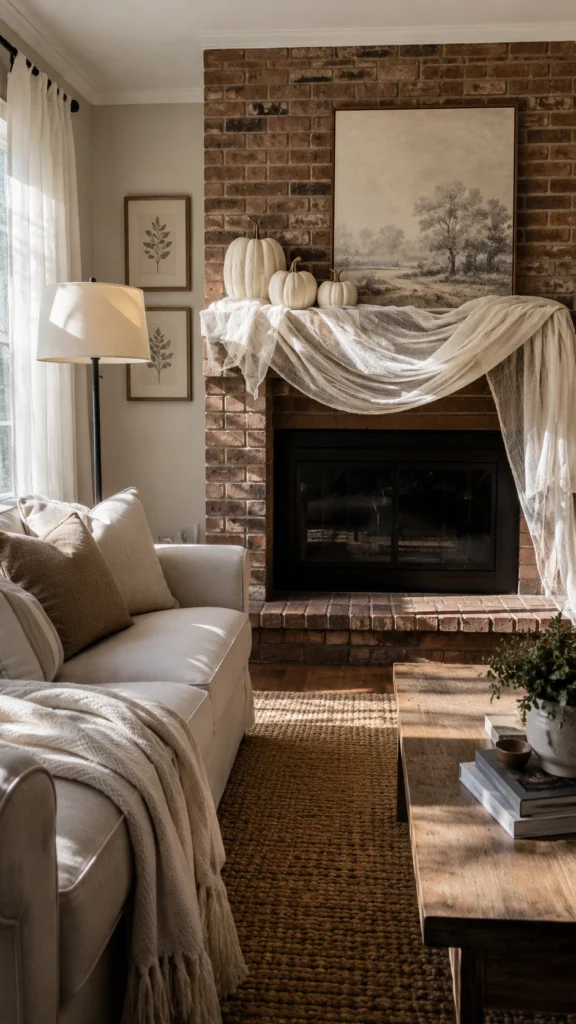
Cheesecloth runs about $5 and does more mantel work per dollar than anything else you can buy. Drape a full length loosely along the top, let it spill over one end, then set three white pumpkins in graduated sizes along the run. Odd numbers look chosen. Even numbers look stiff and matched.
The mistake nearly everyone makes is pulling the cloth tight. Loose, uneven folds throw shadow, and shadow is what makes the whole thing look deliberate instead of rushed. Five minutes, start to finish.
2. Send a Bat Colony Flying Off the Mantel Corner
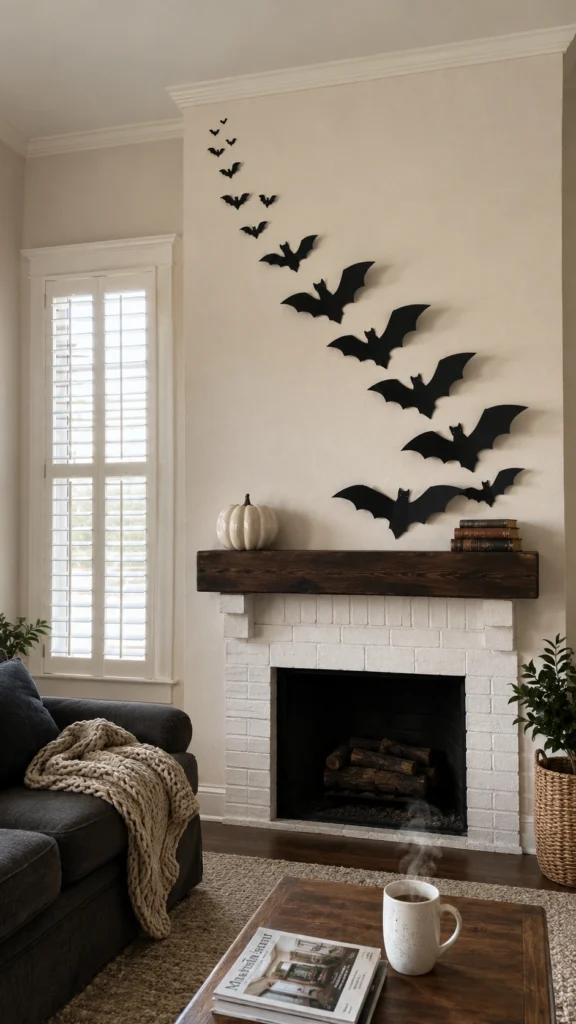
Paper bats climbing diagonally off the mantel and up the wall buy you height without a single large purchase. Use 14 to 18 bats in three different sizes, largest near the mantel, smallest trailing toward the ceiling.
Curve the line. Bats in a tidy grid sit still. A swoop suggests they’re headed somewhere. Removable adhesive putty costs $3 and lifts off flat paint cleanly as long as you peel slowly instead of yanking.
Cheaper route: trace a free template onto black cardstock. Twenty bats for roughly $2.
3. Line Up Five Black Taper Candles at Three Heights
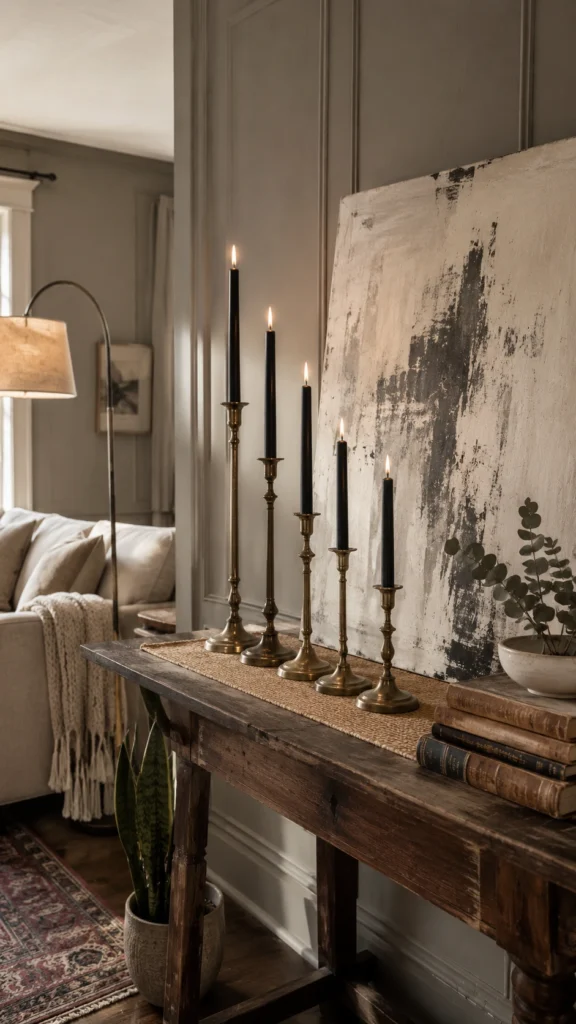
Five black tapers in brass holders, staggered across three heights, look dramatic lit or unlit. Height variation is the entire trick, so buy holders in mixed sizes rather than a matching set. Gothic and warm neutral palettes both take this well.
Flameless tapers with remote timers cost around $20 for six and switch themselves on at dusk, which matters more than it sounds like it should when you’re settled in mid-movie and nobody wants to get up.
4. Hang One Creepy Vintage Portrait as Your Focal Point
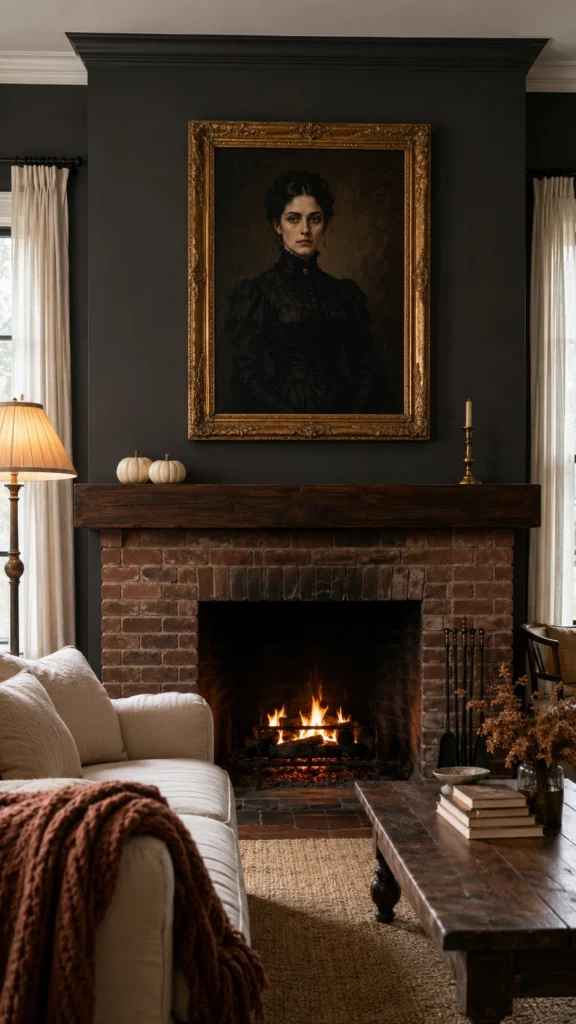
A single moody portrait above the mantel outperforms a dozen small props, and it’s the closest thing to a shortcut here. Swap in a thrifted oil painting, or print a public domain Victorian portrait and slide it into a frame you already own for the price of paper.
Then keep the rest of the mantel low and quiet. One loud element per surface. Two competing focal points on the same shelf cancel each other out.
5. Fill a Tall Vase With Black Branches and Dried Grass
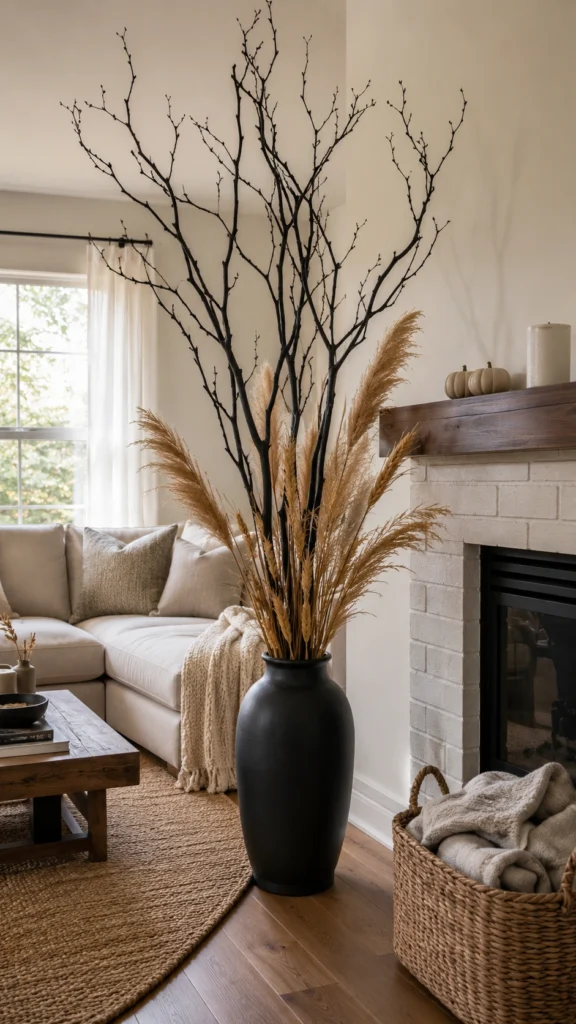
Under $10 of vertical drama that needs no maintenance until December. Cut branches from your own yard, spray them matte black, add a few stems of dried pampas or wheat for texture.
Set the vase off-center on the mantel, or on the floor beside the fireplace. Height at floor level makes a room read taller. This one also survives into Thanksgiving with zero changes, which is more than most of the list can claim.
6. Build a Miniature Haunted Village on the Hearth
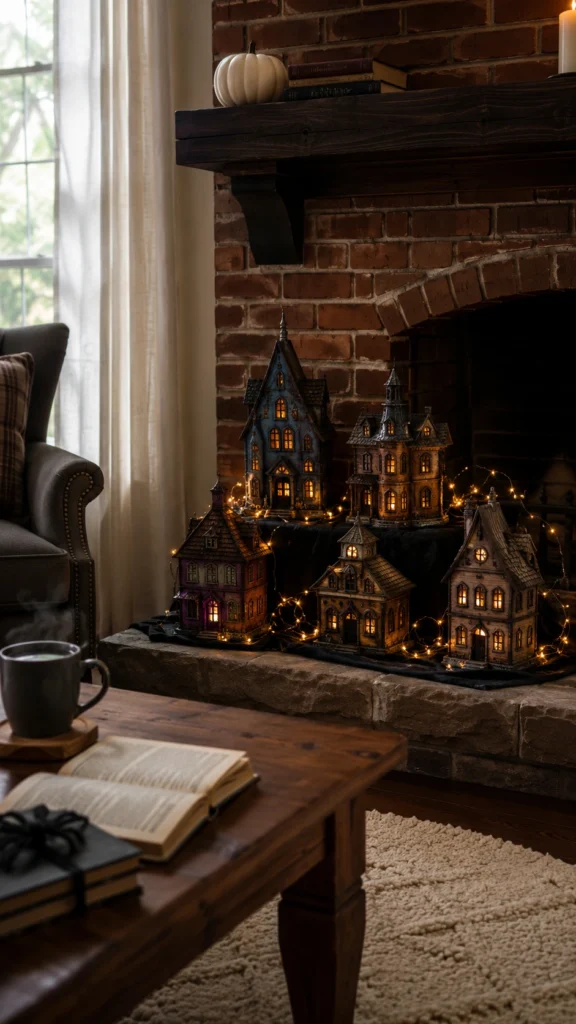
Ground level is where most people stop decorating, so a small lit village on the hearth earns attention partly for existing there at all. Use three to five houses at different heights, propping the back row on books hidden under a length of fabric.
Weave two strands of warm white fairy lights between them. The glow through those little windows does far more after dark than the houses manage on their own.
7. Stack Pumpkins Inside a Fireplace You Never Use
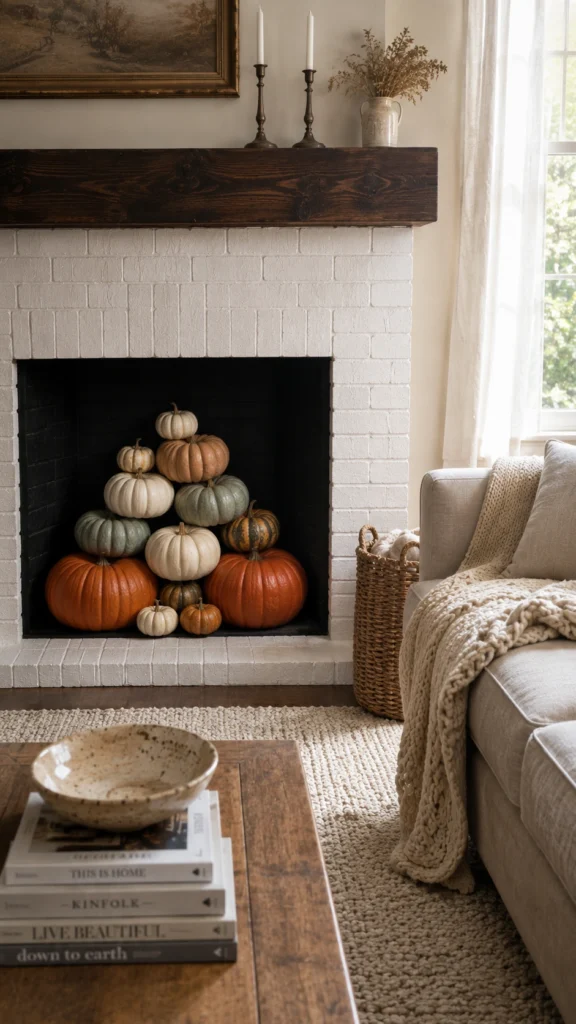
A non-working firebox is free real estate, and an empty black hole in the wall is the least interesting feature in most living rooms. Stack seven to nine pumpkins inside in mixed sizes and colors, largest at the bottom.
Use faux here. Air circulation inside a firebox is poor and real pumpkins soften faster than they would on an open shelf. Mixing white, orange, and pale green keeps the pile looking collected rather than tipped out of a bag.
Related Blog:
8. Turn the Wall Behind Your Sofa Into a Seasonal Gallery
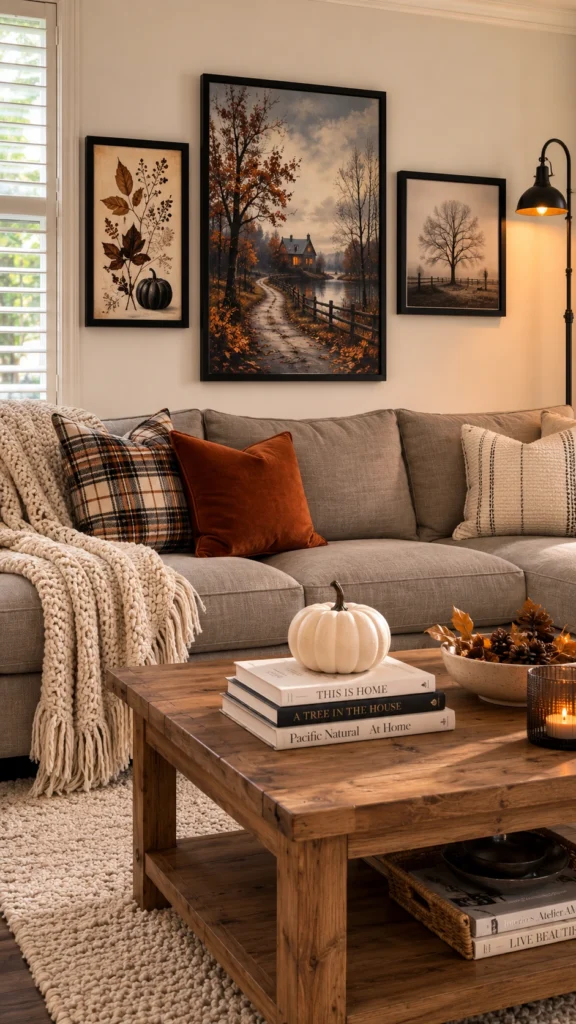
No mantel? The wall behind the sofa takes the job. Pull three prints out of frames you already own, slide seasonal art in, and the room changes in about ten minutes with nothing new going on your walls. Printable Halloween sets run $3 to $8 on Etsy and download instantly.
Match each print to your palette rather than to the other prints. Sets that coordinate too tightly look bought as a set. Renters and apartment dwellers get the most out of this, along with anyone whose living room has no architectural focal point to work with.
9. Style One Floating Shelf Above the Couch
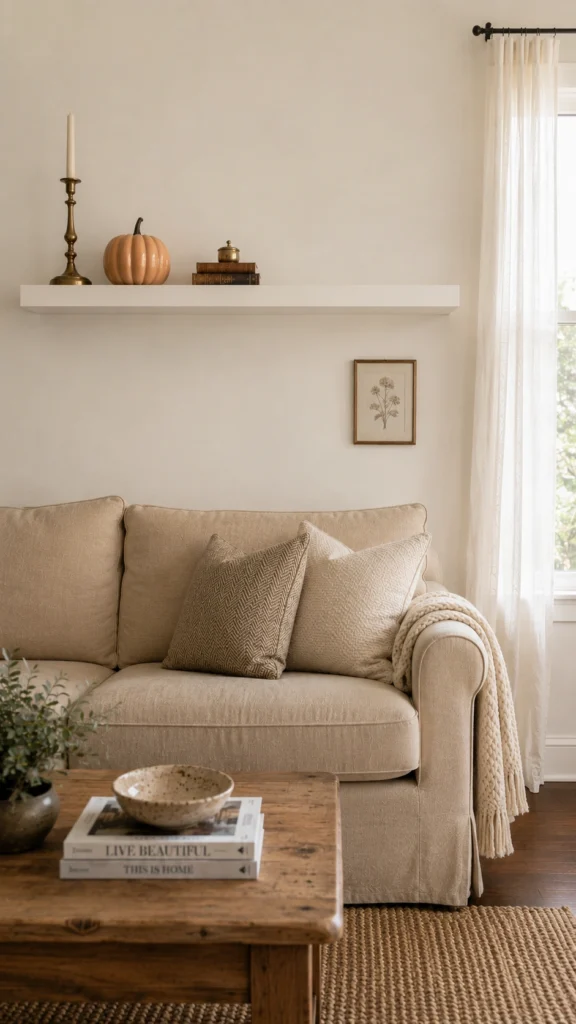
One shelf styled properly beats an entire wall styled halfway. Group three objects at three heights: something tall like a candlestick, something mid-height like a small pumpkin, something low and wide like two stacked books.
Resist spacing them evenly. Cluster toward one side and leave the rest of the shelf bare. Negative space is what separates a styled vignette from a stocked one, and it costs nothing.
10. Fake a Mantel With a Console Table
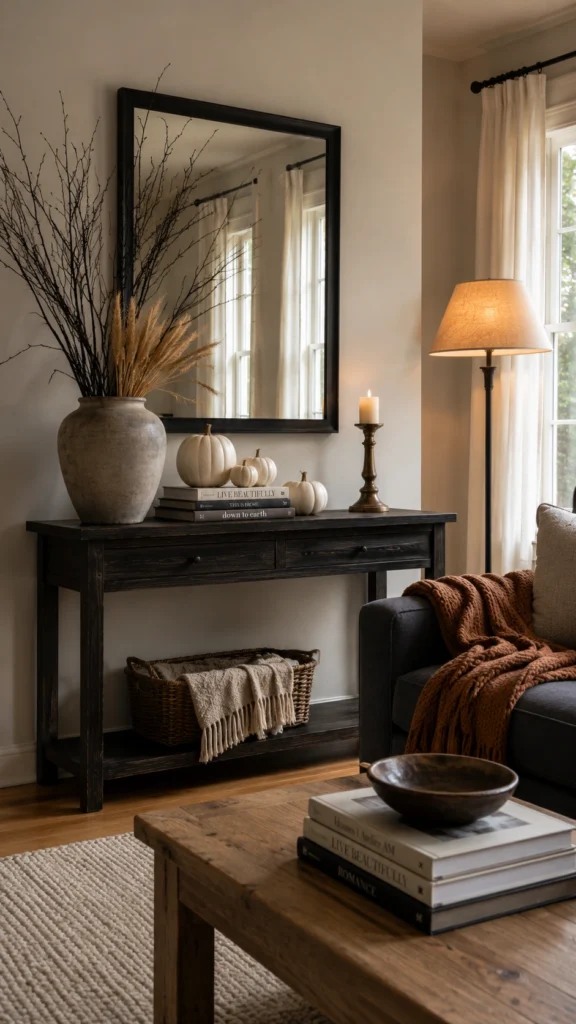
A console behind the sofa or against a blank wall gives you every mantel styling option minus the fireplace. Work in three zones: a tall element at one end, a low grouping in the middle, one small object at the other end.
No console? A narrow bookshelf turned sideways stages the same way, and so does a sturdy bench pushed against the wall.
11. Go Big With One Statement Piece Instead of Ten Small Ones
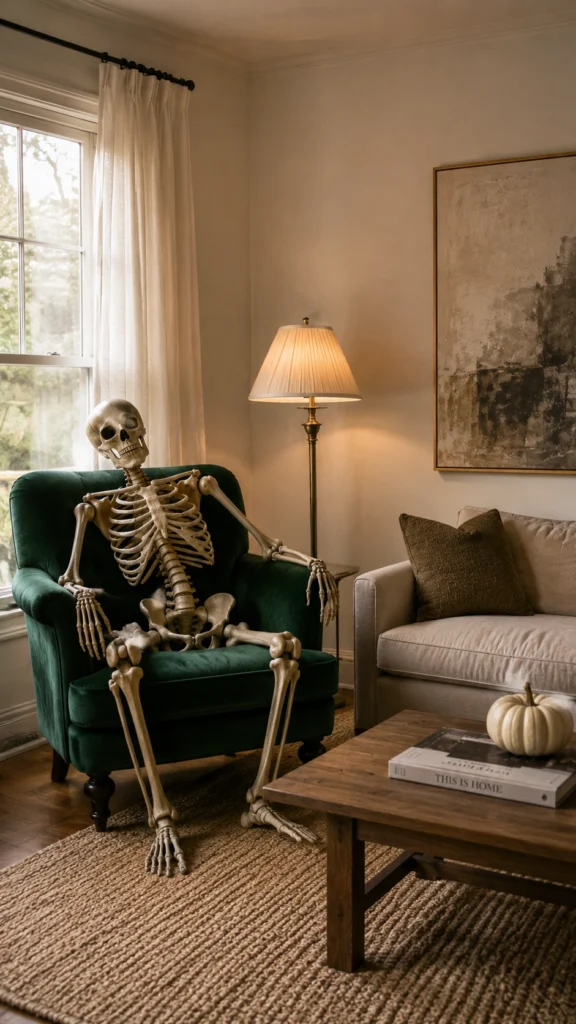
If I could enforce one rule across every Halloween living room, this would be it. One oversized object reads as design. Ten small ones read as clutter, and they usually cost more in total. A three-foot skeleton slumped in an armchair, one large black urn, one big framed print: any of those beats a cart of $6 trinkets.
Scale is what most rooms get wrong. Small props scattered through a large space disappear, so you buy more to compensate, and the buying continues until November.
12. Corral Everything on One 18-Inch Tray
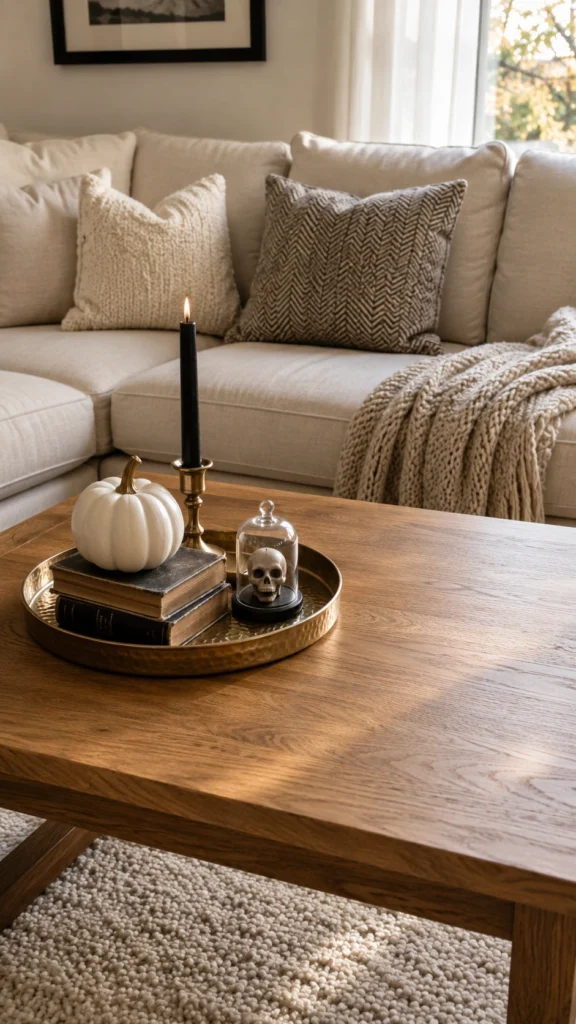
A tray turns random objects into an arrangement. Move every coffee table decoration onto one 18-inch tray and keep at least a third of the table clear for cups, remotes, and feet.
Contrast the shapes. Round tray on a square table, square tray on a round one. Matching shapes flatten the whole surface.
13. Top a Book Stack With a Skull or Ghost
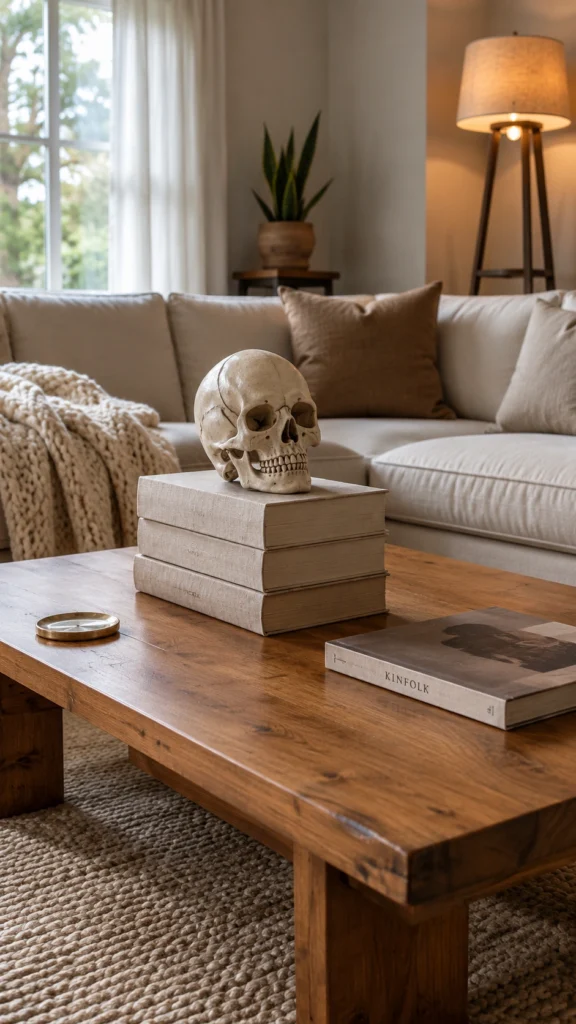
Three hardcovers with a small object on top is the fastest coffee table vignette that exists. Turn the spines inward if the covers fight your palette, or wrap them in kraft paper for a uniform look.
Go matte with the object on top. Glossy plastic skulls photograph badly and look cheap under lamp light, while matte ceramic or resin reads sculptural. The price gap between the two is usually a couple of dollars.
14. Put Something Small and Strange Under a Glass Cloche
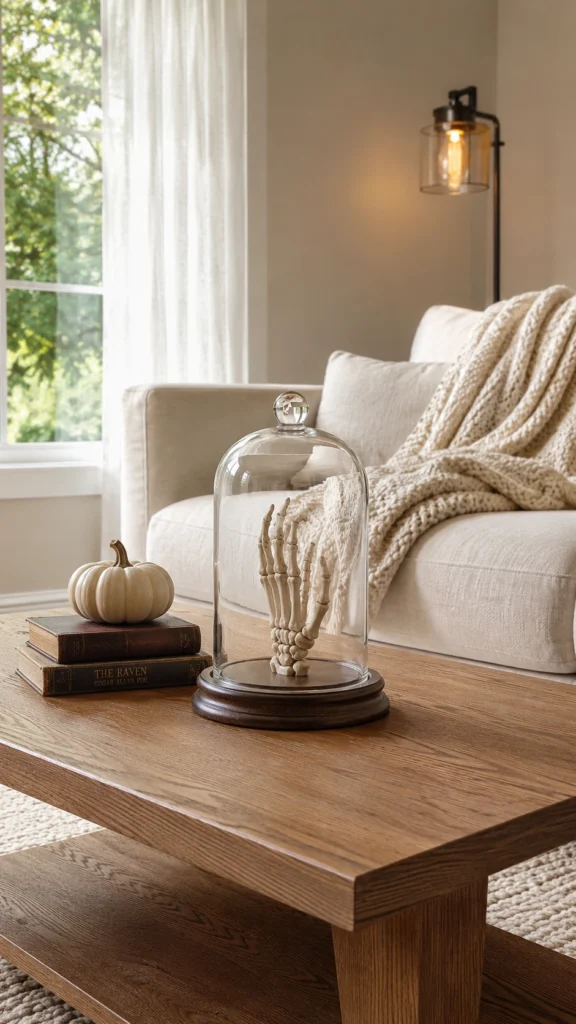
A glass cloche makes anything look precious, including a $4 plastic bat. Slide a skeleton hand, one skull, a mushroom cluster, or a mini haunted house underneath and the dome handles the styling for you.
New ones run $12 to $25. Thrift stores turn them up constantly for a few dollars, usually in the glassware section beside the cake stands. They suit neutral and gothic palettes, and they’re ideal for a coffee table where you want a single object carrying the whole surface.
15. Arrange Black Florals in a Short Vase
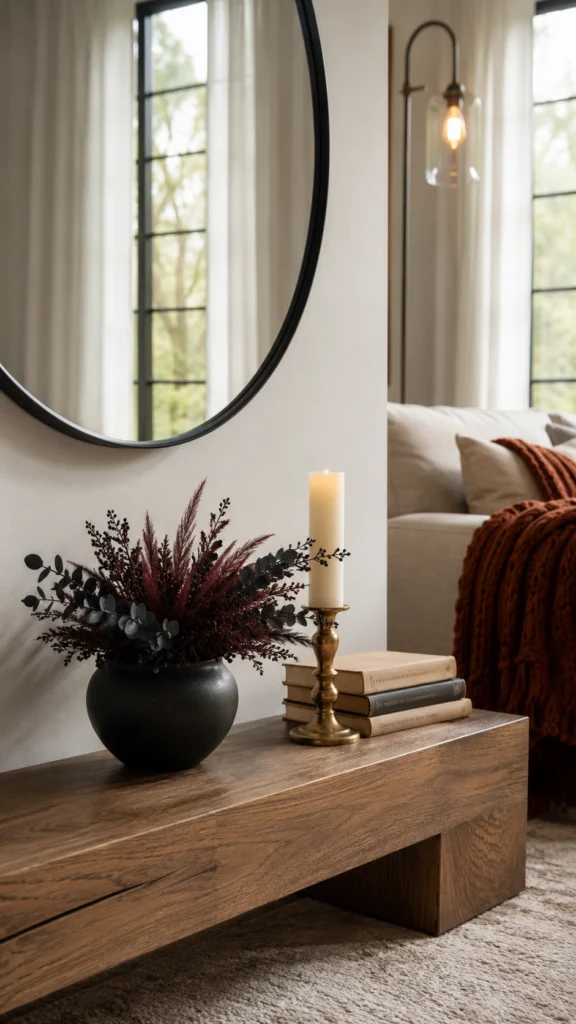
Dark florals bring the season in without a single skull, which helps if someone in your household finds bones tiresome. Use black or deep burgundy faux stems, dried and dyed grasses, or grocery store filler you’ve sprayed yourself.
Keep the arrangement under 12 inches tall so nobody has to lean around it during a movie. A tall centerpiece lasts roughly one evening before somebody relocates it to the floor.
16. Upgrade the Candy Bowl to Something Sculptural
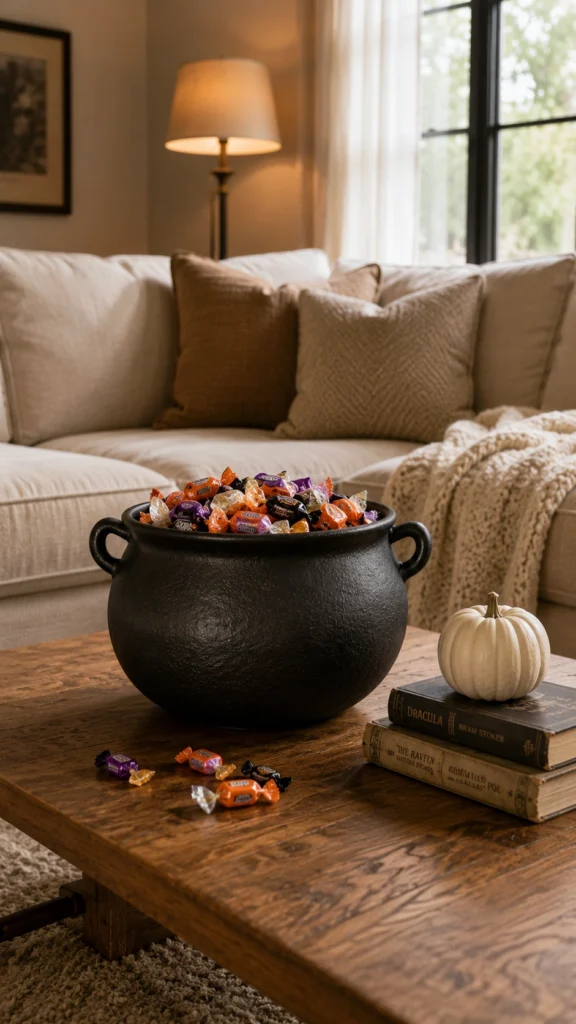
The candy is out anyway, so the container may as well earn its place. A black cauldron, a footed brass bowl, or a skull-shaped dish holds the same fun-size chocolate while counting as decor.
Cheaper version: a thrifted glass trifle bowl for $3 with candy corn layered by color. The stripes read as decoration from across the room, and refills take five seconds.
17. Line Up Apothecary Bottles With Hand-Written Labels
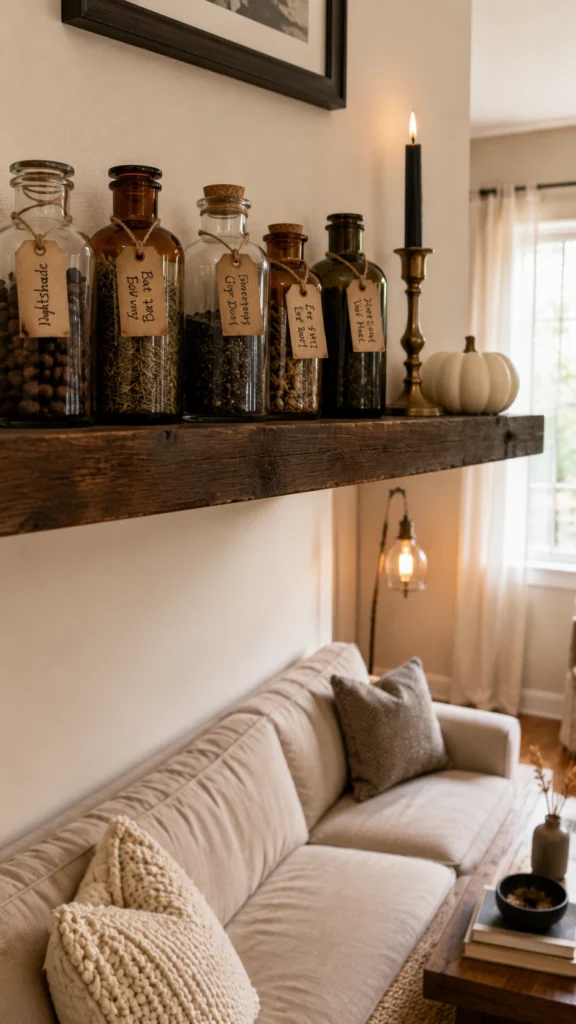
A row of bottles labeled “Nightshade,” “Bat Wings,” and “Graveyard Dust” turns an ordinary shelf into a witch’s cabinet for almost nothing. Save pasta sauce jars, soak the labels off, and fill them with anything dark: coffee beans, dried rosemary, black rice.
Write the tags by hand on kraft paper and tea-stain them. Crooked handwriting on aged paper convinces people. A crisp printed label announces that you bought a kit.
Related Blog:
18. Decorate One Shelf, Not All Five
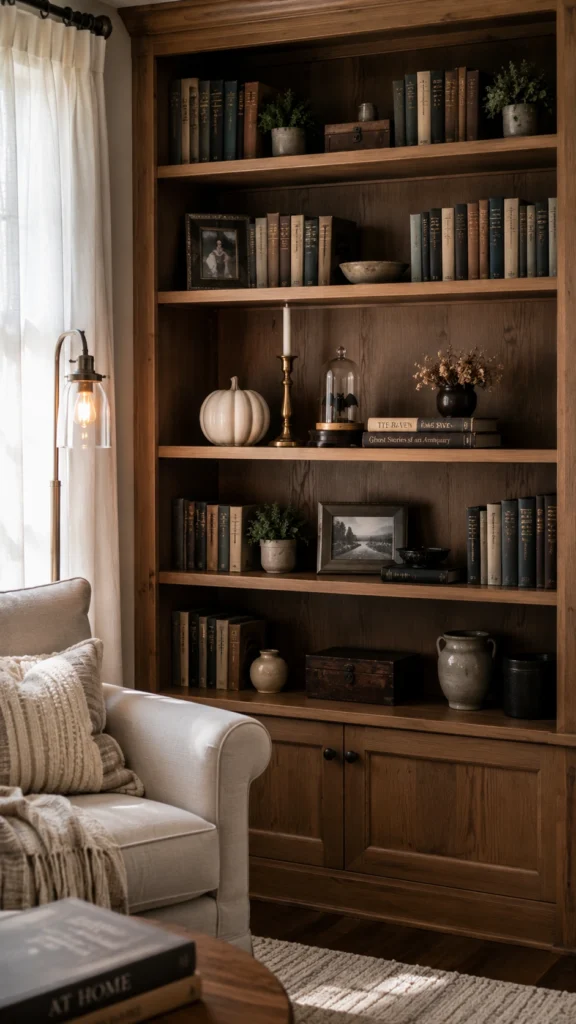
Built-ins tempt you to touch every level, and the result is always busy. Pick one shelf at eye level, style it properly, and leave the others exactly as they are.
The contrast does the work. A single seasonal shelf inside an otherwise normal bookcase pulls the eye straight to it. Teardown takes four minutes instead of an hour, which you’ll appreciate on November 1st.
19. Group Ghost Figurines in Graduated Heights
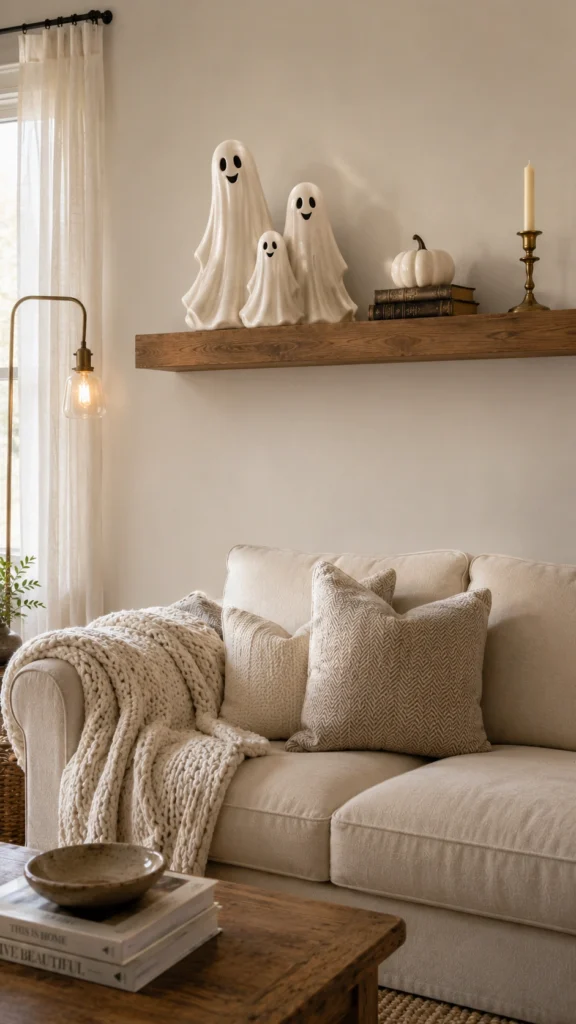
Three ghosts in three sizes, standing together, look like a family. Three identical ghosts in a row look like stock nobody bought.
Ceramic and resin versions cost $8 to $20 each, so build the group across a couple of seasons rather than in one trip. They work best in warm neutral and pastel palettes, and in households where skulls feel like too much.
20. Pull Four Everyday Objects and Swap in Four Spooky Ones
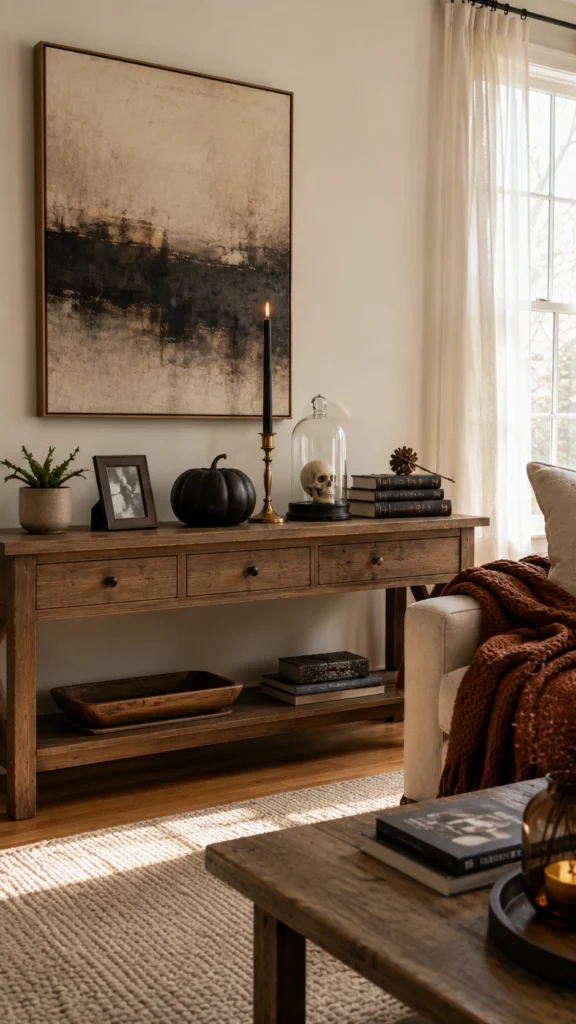
This is the principle worth stealing for the entire room. Instead of adding decor on top of what’s already there, remove four objects and put four seasonal ones in their place. Your surfaces carry the same visual weight as before, so the room never tips into cluttered.
Adding without subtracting is how a styled living room turns into a Halloween storage unit by October 20th. It happens gradually, which is why nobody notices until there’s no room on the coffee table for a mug.
Related Blog:
21. Follow the Two-Pillow Rule on Every Sofa
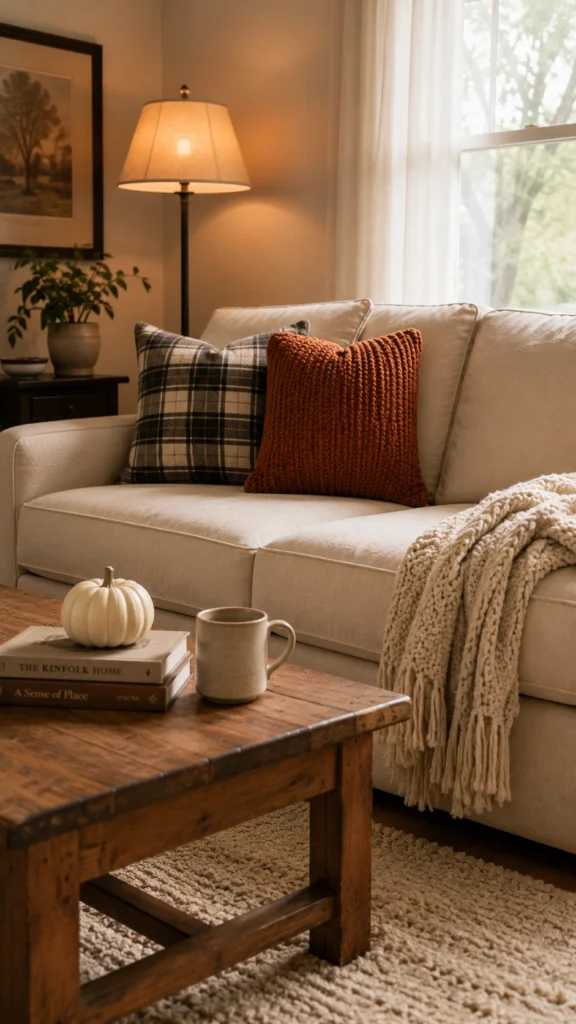
Two seasonal pillows per sofa, maximum. One printed, one textured. That pairing looks intentional and costs a fraction of a full set.
Buy covers rather than whole pillows. Twelve covers fold into a shoebox, while twelve pillows demand their own bin and eventually their own corner of the closet. Covers run $8 to $15 each and the inserts you already own handle the rest.
22. Drape the Throw Blanket, Don’t Fold It
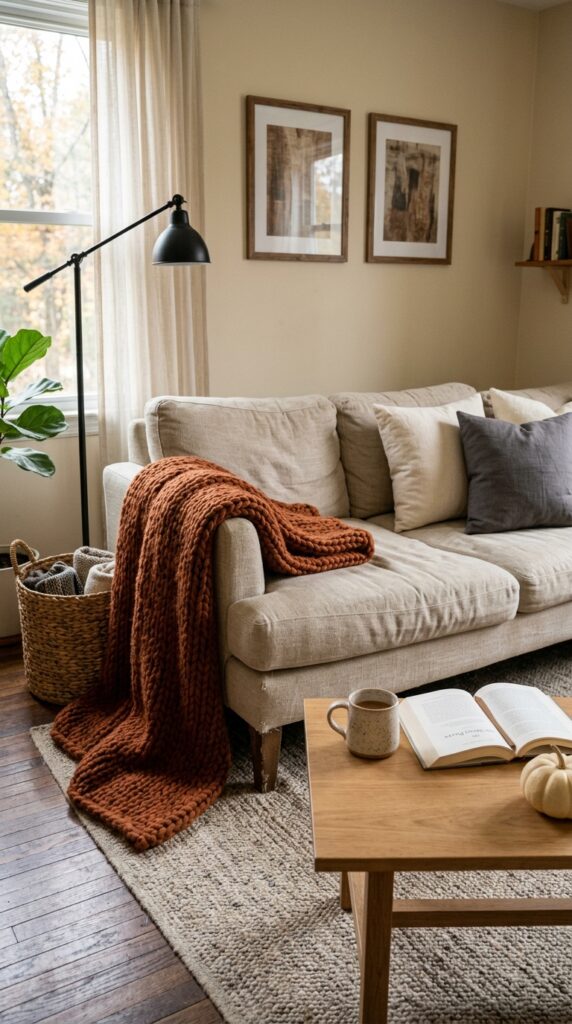
A blanket folded into a crisp rectangle looks staged. Draped over one arm of the sofa with the corner falling toward the floor, it looks like a room somebody actually uses.
Pick a chunky knit in black, rust, or cream over a printed Halloween throw. Texture carries the season and still looks right on November 15th, which is about the point where anything covered in bats starts to feel late.
23. Layer a Dark Runner Over Your Existing Rug
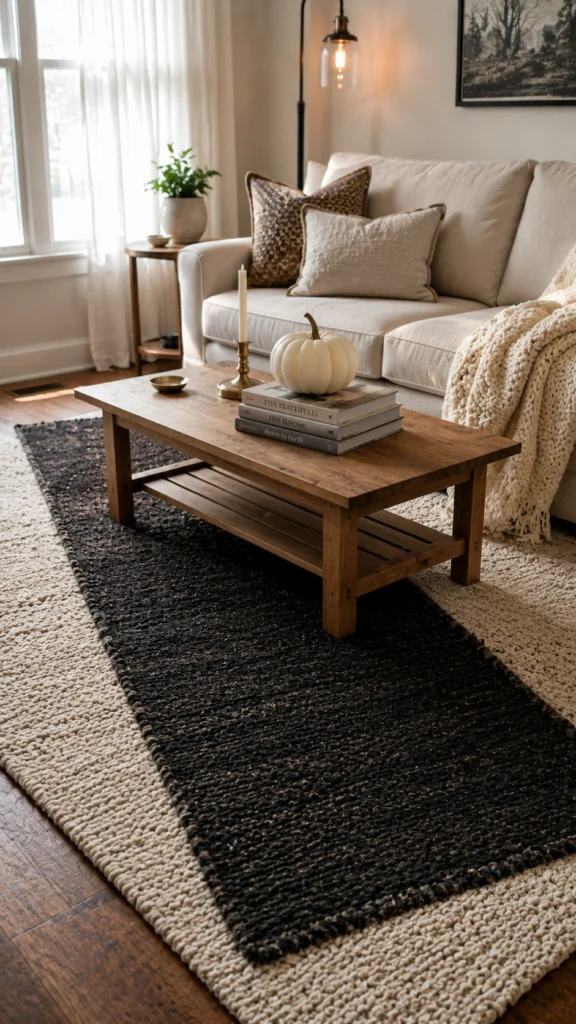
For $30 to $60 you can change the entire floor plane without touching what’s underneath. Low pile over high pile, dark over light, set at a slight angle rather than perfectly square.
This pays off most in rooms with a pale neutral rug, the kind that swallows every dark object you set on it. Ground the floor and everything above it looks richer. Very small rooms are the exception, since a second rug in a tight space can make the floor feel crowded rather than deliberate.
24. Give One Armchair a Skeleton Throw
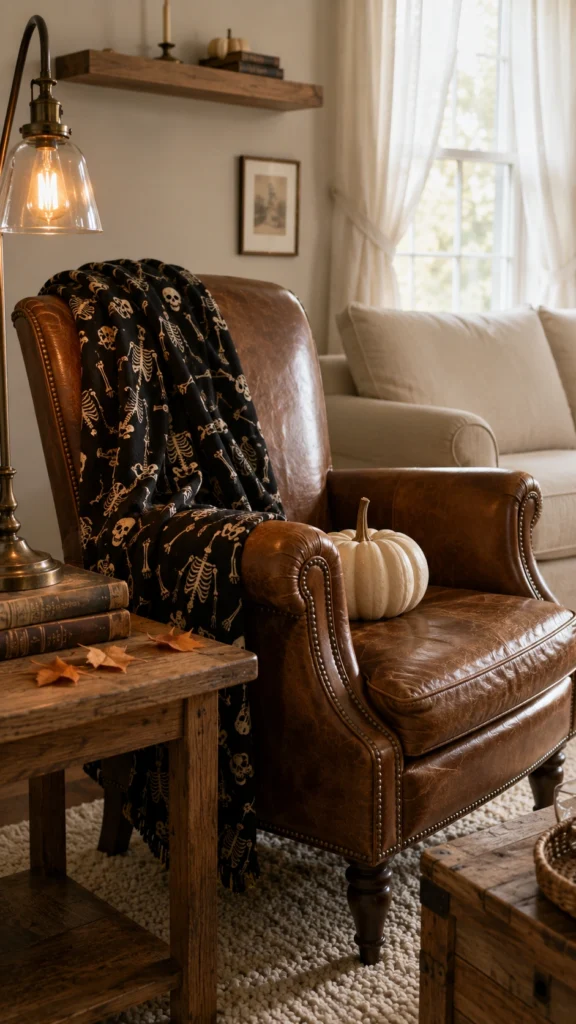
Claim one chair for Halloween and let the rest of the seating stay normal. A skeleton-print or bat-print throw over a single armchair creates a focal point, and one committed piece of furniture beats seasonal accents sprinkled across five.
Put a small pumpkin or a folded-open book on the seat. An empty decorated chair looks staged. A chair with one object on it looks like somebody just stood up.
25. Float Witch Hats From the Ceiling on Fishing Line
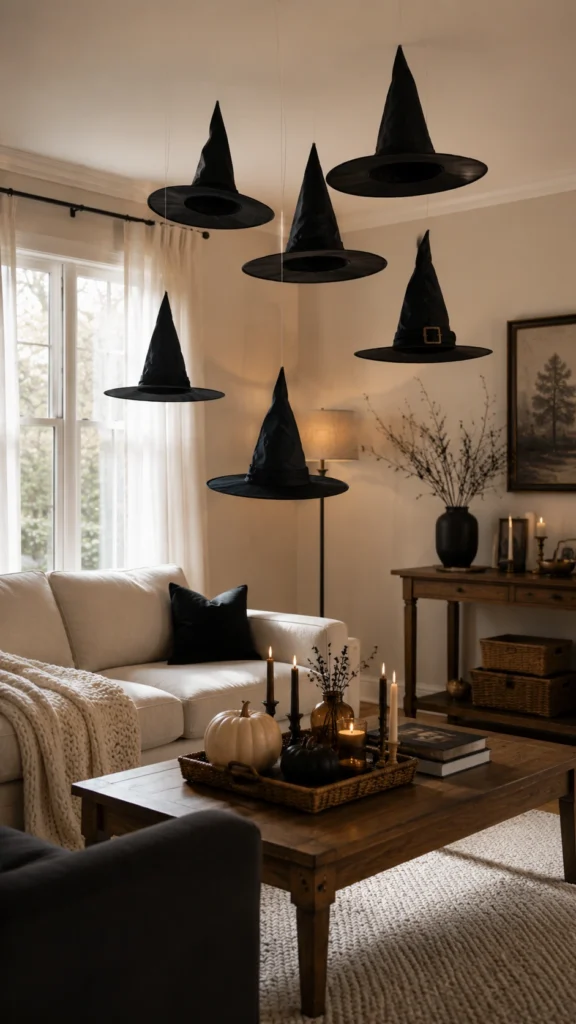
Floating witch hats are the most photographed Halloween living room idea online, and five of them cost under $20. Tie clear fishing line to each hat, hang at staggered heights, and use adhesive ceiling hooks rated for at least one pound.
Keep the lowest hat at 7 feet minimum so nobody wears one by accident. Vary the drops by four to six inches, since identical heights look like a store display. Test one hook first if you have textured or popcorn ceilings, because adhesive holds poorly on those and finding out with five hats already tied is a bad afternoon.
26. Hang a Bat Mobile Over the Coffee Table
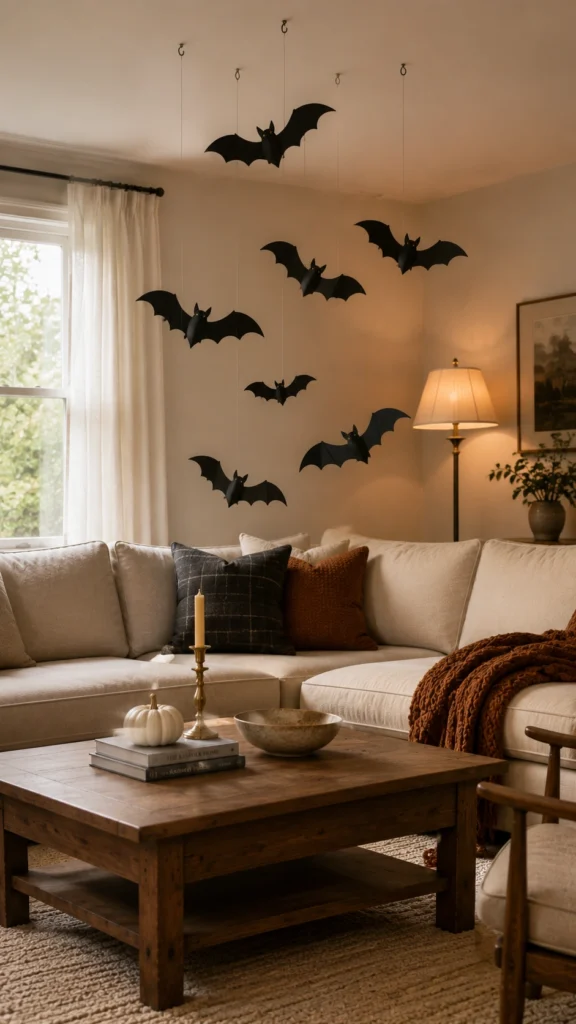
The vertical space above a coffee table sits empty in nearly every living room. A cluster of five to seven bats on fishing line at mixed heights, anchored to two or three ceiling hooks, fills it.
Keep it over furniture, never over a walkway. Head clearance in dim lighting is not something you want to test on guests.
27. Run a Leaf Canopy Across One Corner
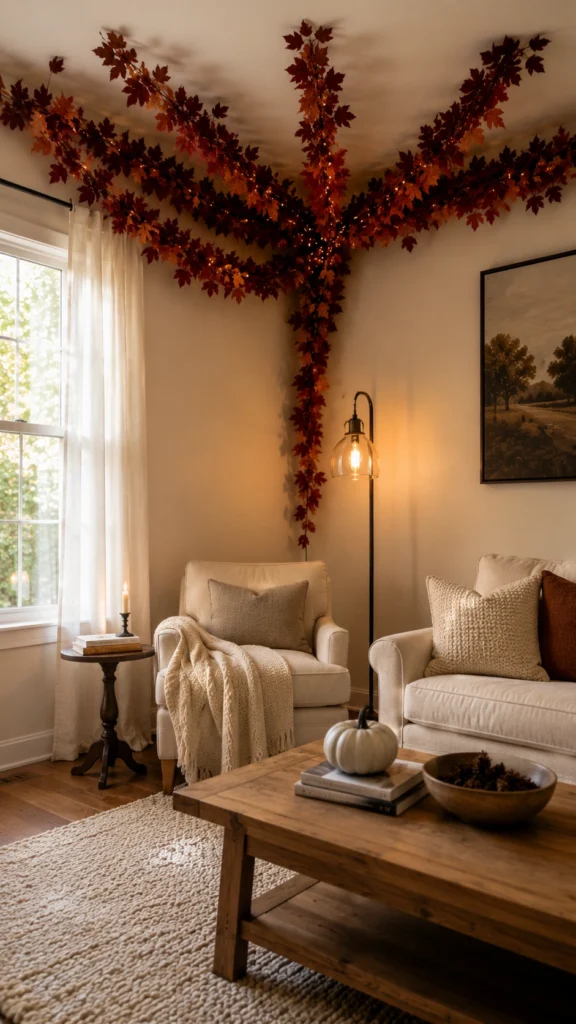
A leaf garland canopy across a single corner gets you the maximalist look without committing your whole ceiling. Anchor three or four garlands at one corner point and fan them outward.
One corner instead of the entire room drops the cost to about $15 and the setup to fifteen minutes. I’d argue it looks better too. Concentrating the garlands in one spot creates a feature, while spreading them across the ceiling just looks unfinished.
28. Stick One Giant Spider on the Wall
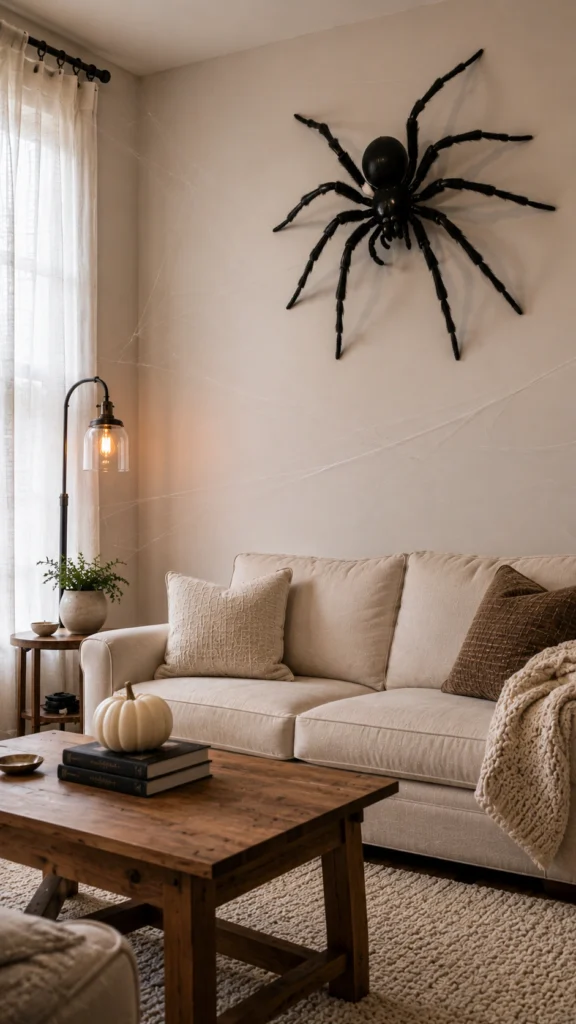
One spider roughly the size of a dinner plate unsettles people far more than twenty small plastic ones. Mount it high on a plain wall with removable putty, slightly off-center.
Stretch webbing thin across the corner behind it, pulled until it’s nearly transparent. Thick clumps of webbing look like cotton balls, and nobody has ever been frightened by a cotton ball.
29. Hang Wreaths in Your Living Room Windows
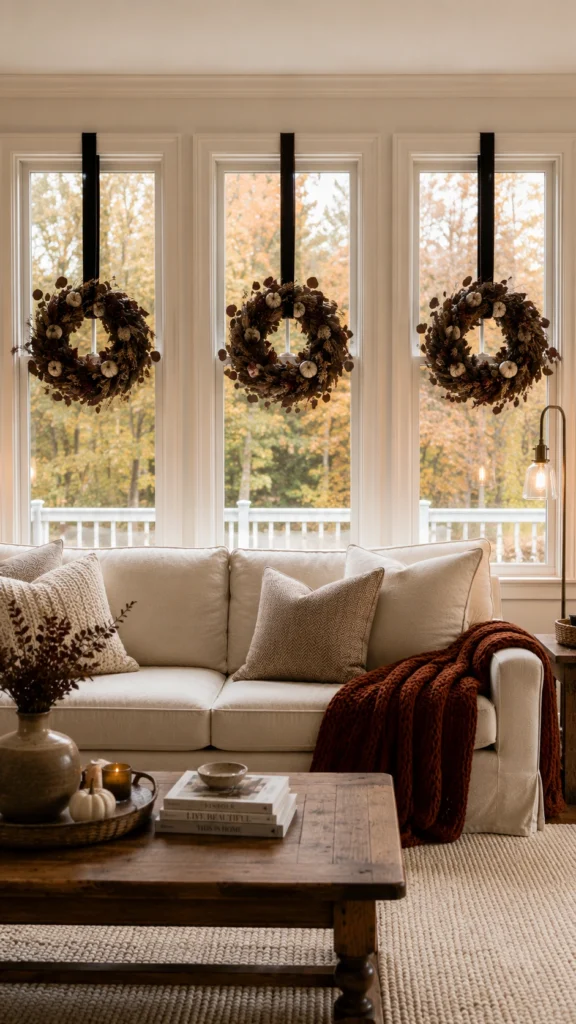
Interior windows take wreaths, and almost nobody uses them that way. Hang one dark wreath per window from a length of black ribbon looped over the top of the frame, so you drill nothing and patch nothing in November.
Symmetry is the right call here, unusually for this list. Matching wreaths across two or three windows create the polished look that makes a room read designed. It only holds up if the windows themselves match, though. One wreath on one window out of three looks like you ran out.
30. Swap Three Bulbs to 2200K Amber and Kill the Overhead
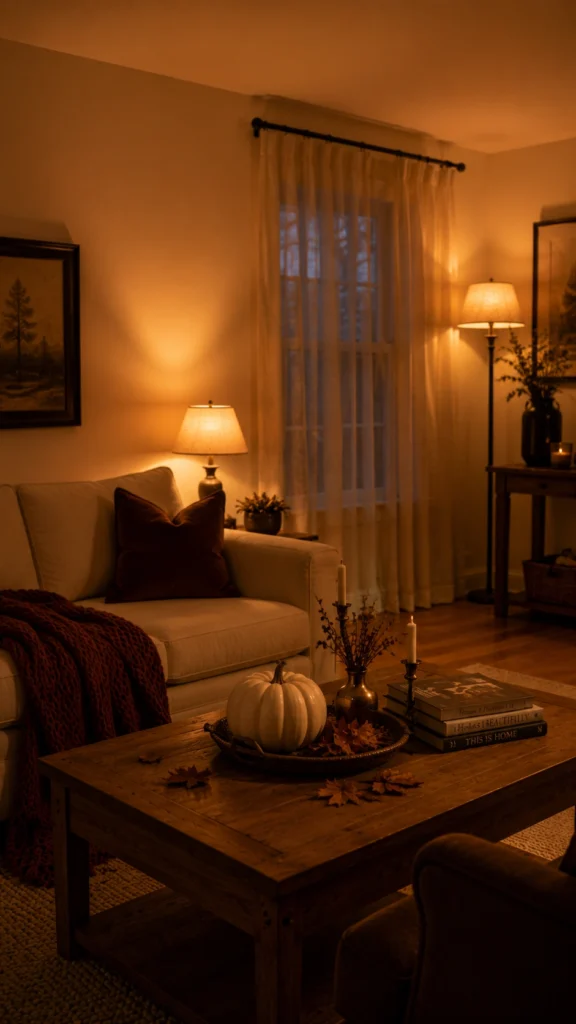
Cheapest transformation on the entire list, and I’d do it before buying a single decoration. Replace three lamp bulbs with 2200K amber LEDs, turn the overhead light off completely, and the room moves into candlelit territory for about $12.
Standard warm white sits at 2700K and reads clean. Amber at 2200K reads closer to firelight. Every moody Halloween living room photo you’ve admired online is running lamps at that temperature with the ceiling fixture off, and the second part isn’t optional. One bright overhead undoes three amber bulbs instantly.
31. Hide a Puck Light Behind Your Pumpkin Cluster
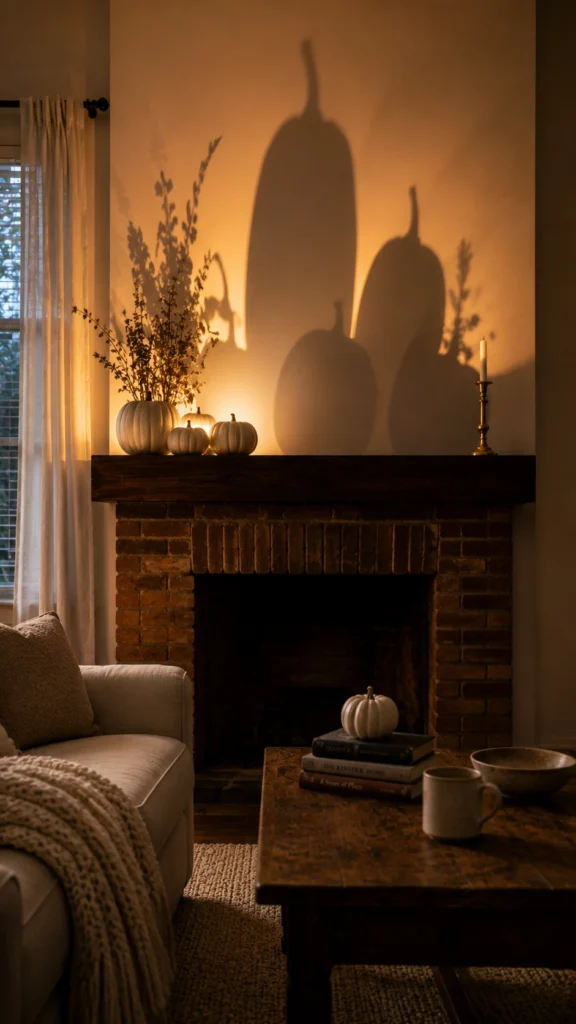
A single battery puck light tucked behind a pumpkin grouping or a plant throws light upward and casts shadows on the wall. Around $12 for a three-pack, and setup takes about ten seconds.
Aim it so the shadow lands on a bare stretch of wall rather than across a picture frame. Retail displays build atmosphere this exact way, and it works the same in a living room for a fraction of what they spend.
32. Set Flameless Tapers on a Timer
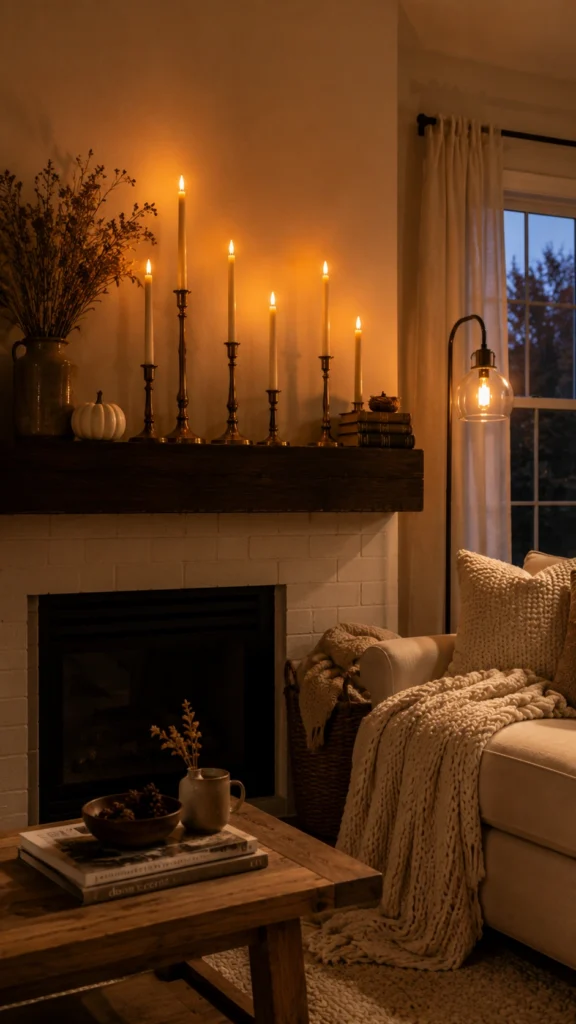
Real candles near cheesecloth, webbing, and dried branches create a genuine fire risk, which none of the pretty photos online bother to mention. All three materials catch quickly. Flameless tapers with remote timers remove the problem and switch themselves on at dusk.
Look for the ones with an off-center flicker rather than a steady glow, since the steady ones look like exactly what they are. Use them on any surface holding fabric, paper, or dried plant material, which on this list covers most of them.
33. Let Your TV Do the Haunting
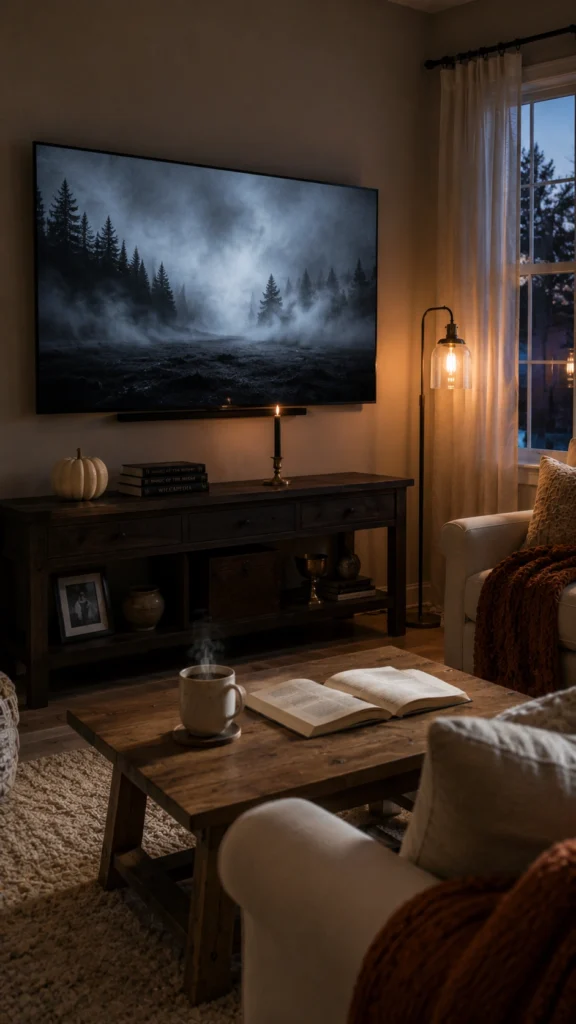
That large black rectangle above your mantel counts as decor for eleven months of the year, so put it to work for the twelfth. Run an ambient fireplace loop, a flickering candle screen, or a slow-drifting fog video on YouTube while you host.
Choose loops without music. Silent ambient video sets the mood, while a looping horror soundtrack empties the room in about twenty minutes. Somebody will ask you to turn it off well before that.
Related Blog:
34. Redress Your Christmas Tree as a Halloween Tree
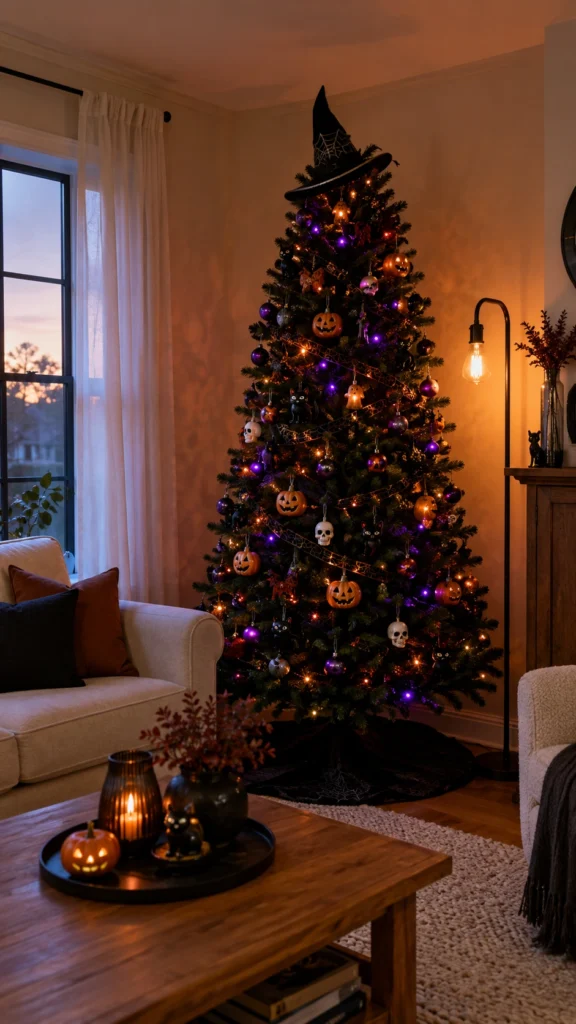
Your artificial tree sits in a box eleven months a year, so October is a reasonable time to get some use out of it. Set it up with 20 to 24 ornaments in your palette, a black bunting, orange or purple lights, and a witch hat on top.
Halloween trees keep gaining ground because they deliver a large focal point using equipment you already own. Leave the Christmas ornaments in their box, though. One stray glass snowflake gives the whole thing away.
35. Set a Two-Foot Tabletop Halloween Tree on the Console
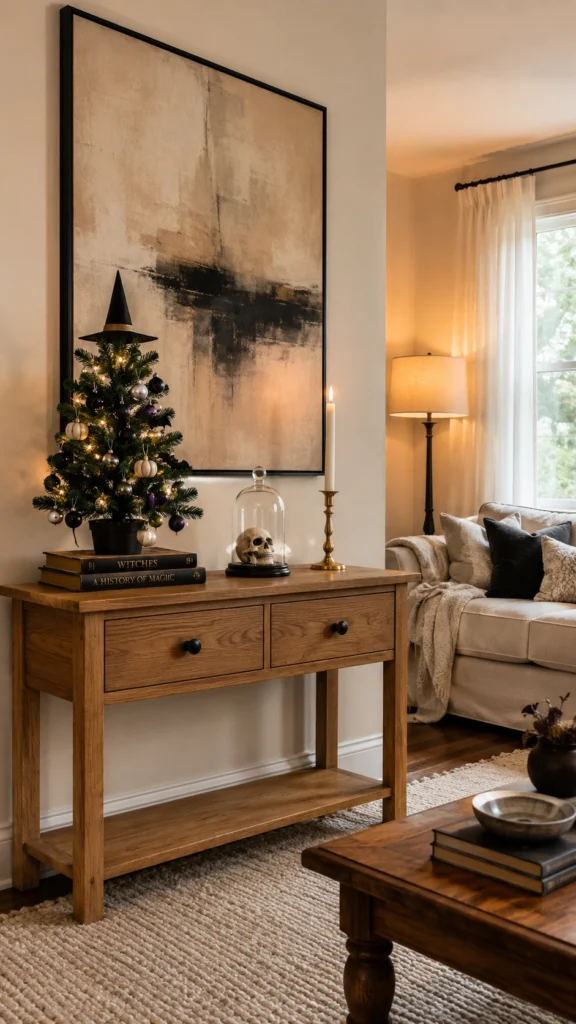
Apartments and small living rooms get the same effect from a two to three foot tabletop tree on a console or side table. Cost runs $20 to $35, and the whole thing stores in a grocery bag.
Set it on two stacked books. A slightly raised object reads as a display, while the same object flat on the surface reads as something you put down and forgot about.
Halloween Living Room Safety Nobody Mentions
- Keep open flames away from webbing, cheesecloth, and dried branches. All three catch fast. Use flameless candles anywhere near fabric or paper.
- Watch the small props around pets and toddlers. Plastic spiders, small bones, and fake candy are choking hazards, and a cat will absolutely eat a foam pumpkin.
- Skip floor-level decor in walkways. Extension cords and low props in dim lighting cause more Halloween injuries than anything designed to frighten people.
- Real pumpkins indoors last four to six weeks uncarved, and five to ten days carved. Wiping the cut edges with a diluted bleach solution buys you a few extra days.
Storing It So Next October Takes 90 Minutes
Sort your bins by room and zone rather than by object type. One bin labeled “living room mantel” beats four bins labeled “candles,” “pumpkins,” “fabric,” and “misc.”
Photograph every finished vignette before you take it down, too. Next September you’ll rebuild the whole room from your camera roll in an hour and a half instead of starting the design decisions over from nothing.
Recommended Blogs
- 22 Halloween Decor Ideas for a Spooky Chic Home
- 20 Halloween Party Decor Ideas for a Spooky Bash
- 30 Halloween Kitchen Decor Ideas You’ll Wish You Tried Sooner
- 24 Halloween Kitchen Decor Ideas for Spooky Fun
Final Thoughts
You don’t need all 35 of these Halloween living room decor ideas. Four or five that match your palette will carry the entire season, and three well-styled surfaces beat twelve half-finished ones every time.
The shortest route, if you want one: swap three bulbs to amber, put everything on the coffee table onto a single tray, drape cheesecloth with three pumpkins on your mantel or console, and add two pillow covers. Four ideas, roughly $50, about forty minutes.
Do the lighting tonight. Amber bulbs and a dark ceiling fixture change more than any object you could buy, and once the room glows properly, you’ll see exactly where the pumpkins want to go.
FREQUENTLY ASKED QUESTIONS
How do you decorate a living room for Halloween without a fireplace?
Use the wall behind your sofa or a console table as the focal point instead. Swap the art inside frames you already own, style one floating shelf with three objects at three heights, and add height with a tall vase of black branches on the floor. What a mantel actually provides is elevation and a single place for the eye to land, and you can build both without one.
How do you make Halloween decor look expensive instead of cheap?
Choose matte finishes over glossy plastic, group objects in odd numbers at varied heights, and hold to one palette. Then subtract. Most rooms look cheap because they hold too many small props, not because the individual pieces cost too little. One large object beats ten small ones at the same total spend.
What Halloween living room decor ideas work best for renters?
Removable adhesive hooks and putty-handle bats, spiders, and wreaths with no wall damage. Fishing line on ceiling hooks holds witch hats and bat mobiles. Pillow covers, throws, layered rugs, tray vignettes, and bulb swaps need no mounting at all, and between them they cover roughly two-thirds of this list.
When should you decorate your living room for Halloween?
Put the harvest base up in mid-September, then add the spooky layer on October 1st. Shopping in late September also gets you full stock. The best cauldrons, ceramic ghosts, and cloches sell out by mid-October and rarely come back.
How much does it cost to decorate a living room for Halloween?
About $50 covers a genuinely finished-looking room using amber bulbs, paper bats, cheesecloth, faux pumpkins, and printable art. Between $100 and $150 adds textiles, flameless candles, and hanging elements. Past $300, you’re buying larger pieces like a Halloween tree or a layered rug that last for years.