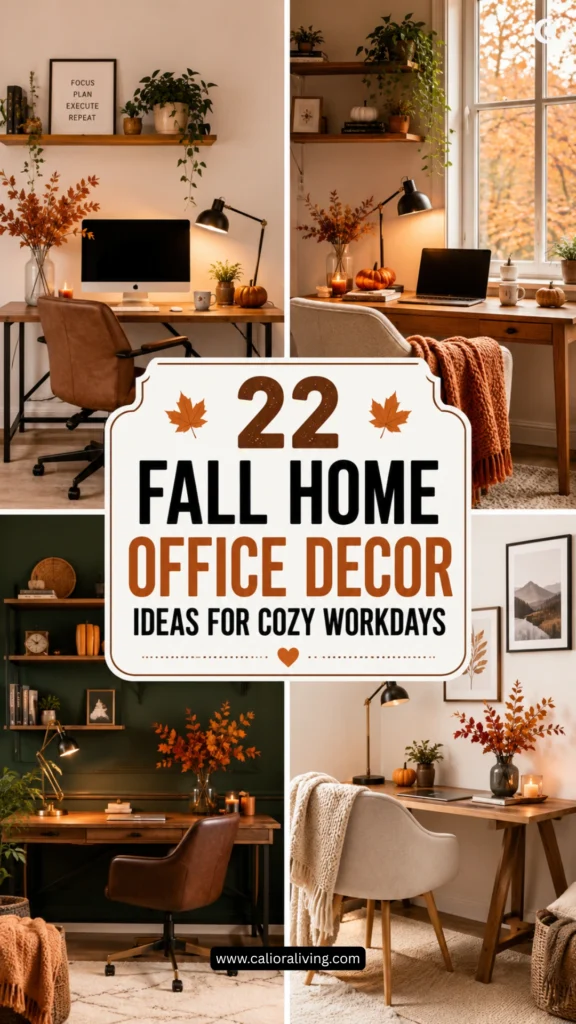

By four in the afternoon in late October, the daylight in most home offices is already gone. Your desk lamp is doing all the work, the walls read grey, and the same room that felt perfectly fine in July now feels like somewhere you tolerate for eight hours rather than somewhere you want to sit.
Nothing about the room changed. The light did.
Good fall home office decor works with that shift instead of pretending it isn’t happening. Warmer bulbs, heavier textures, and a few seasonal pieces change how the space feels, and most of it takes less than an hour. No renovation, no dragging your desk to the opposite wall.
Below are 22 fall home office decor ideas worth doing this week, including the parts people usually get wrong.
1. Swap Cool White Bulbs for 2700K Warm LEDs
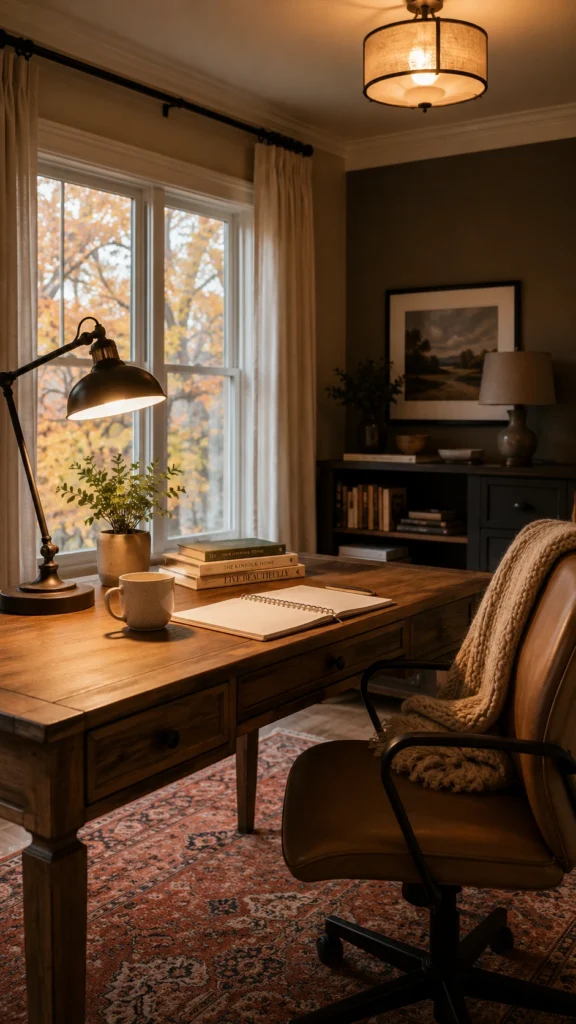
If you change one thing on this entire list, make it the bulbs.
Cool 5000K light works beautifully in a kitchen and badly in a room where you sit for eight hours in November. Move your desk lamp and overhead fixture to 2700K or 3000K LEDs, roughly $4 a bulb, and the room warms up before you’ve bought anything else. Keep the brightness where it was, around 800 lumens for a desk lamp, so you gain warmth without squinting at spreadsheets.
Match the temperature across every bulb in the room while you’re at it. One leftover daylight bulb in a corner fixture cancels out the other three.
2. Layer a Rust-Toned Low-Pile Rug Under Your Desk
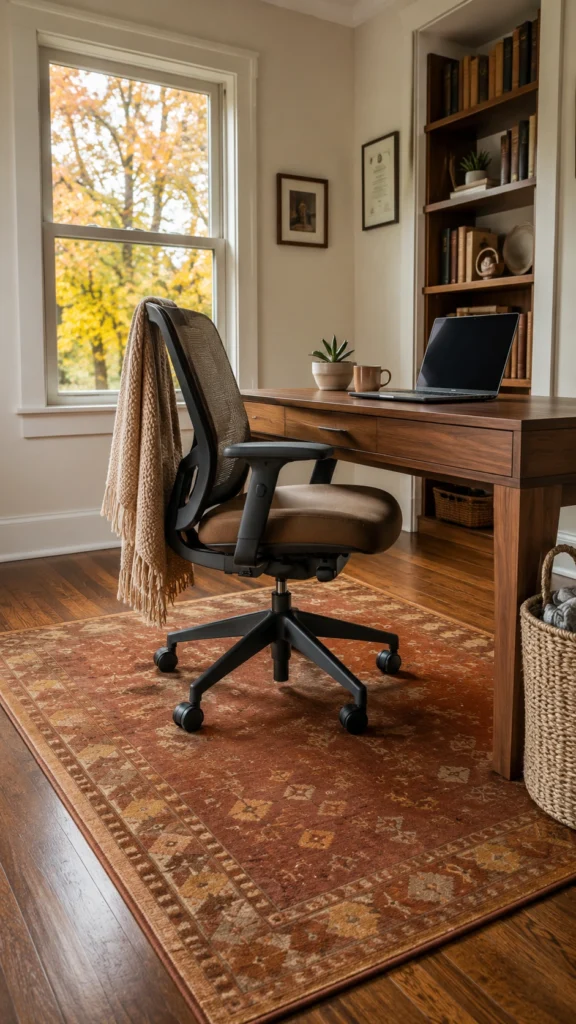
Hard floors do two annoying things in autumn. They bounce sound around during calls, and they get cold under your feet by mid-October. A rug handles both at once, which is why it belongs near the top of the list for anyone working in a room with laminate, tile, or bare boards.
Stay at 5mm pile or less. Anything thicker and your chair casters stop rolling, so every reach toward the printer turns into a small wrestling match.
Rust, ochre, and faded terracotta read as autumn without looking like decoration you’ll need to box up in December. That matters more than it sounds, since you probably don’t want to swap a rug twice a year.
3. Drape a Chunky Knit Throw Over Your Office Chair
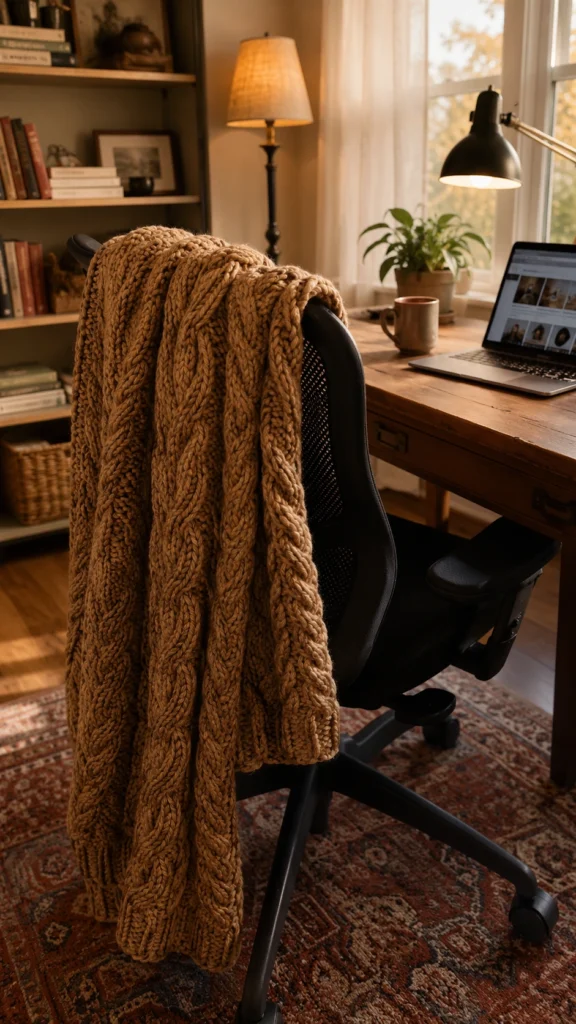
Twenty-five dollars buys a throw that changes how the room looks from the doorway, which is a better return than most things at that price.
Wool and cotton blends hold their shape. Cheap acrylic flattens after a month of you leaning back into it and never recovers. Fold the throw in thirds and hang it over one shoulder of the chair rather than centering it neatly, since a perfectly symmetrical drape looks staged.
Watch the bulk. A throw thick enough to sit between your spine and the chair’s lumbar support will make itself known by Thursday afternoon.
Related Blog:
4. Add a Faux Sheepskin Seat Pad
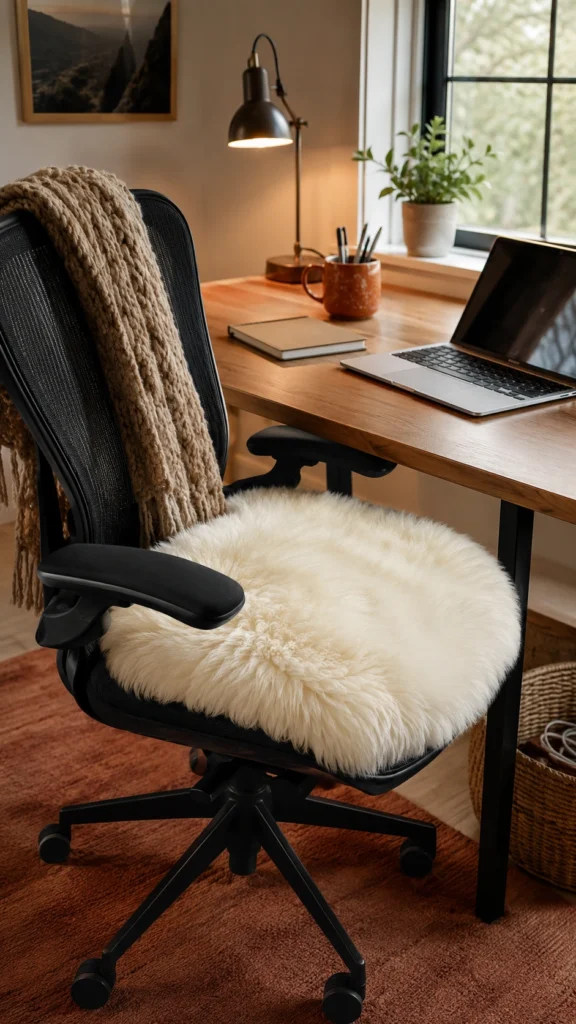
Mesh office chairs are excellent in August and genuinely unpleasant once your heating starts fighting a drafty window. A faux sheepskin pad fixes that for around $20.
Buy one with a non-slip backing or tie straps. Loose pads slide forward every single time you stand up, and you’ll spend the winter repositioning it. Give it a shake once a week too, because fluffy surfaces collect crumbs at a speed that surprises people.
Not ready to spend? Fold a fleece blanket in half and tuck the ends under the seat edge. Under $12 and it covers most of the same ground.
5. Build a Three-Pumpkin Vignette on a Floating Shelf
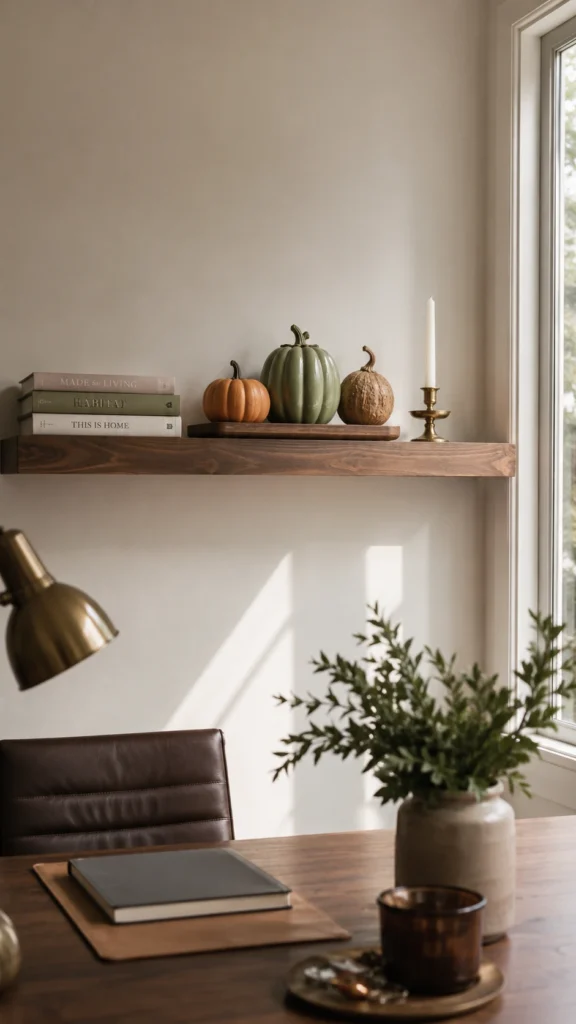
Three pumpkins in different heights and finishes look considered. Five identical ones in a row look like a shop display.
Try one real mini pumpkin, one matte ceramic, and one dried gourd on a small wooden riser. Put the group at roughly eye level when you’re seated, not up near the ceiling where you’ll never actually look at it. Odd numbers and uneven heights do the work here, and that principle carries over to almost every surface you style this season.
Related Blog:
6. Fill a Stoneware Vase With Dried Wheat and Eucalyptus
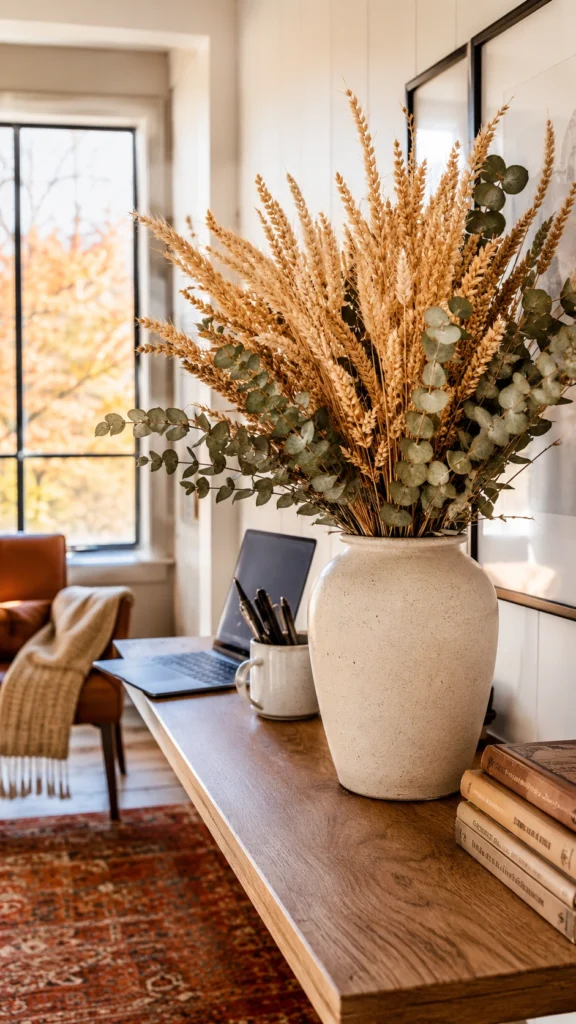
Fresh flowers on a desk die by Wednesday, and then you feel mildly guilty every time you look at them.
Dried wheat, bunny tail grass, and preserved eucalyptus hold up all season for about $10 a bunch. Trim the stems so the arrangement stands roughly 1.5 times the height of the vase. Much taller and it looks top-heavy, much shorter and it looks like the vase swallowed it.
Stoneware and matte ceramic suit dried textures better than clear glass, which puts every bunched stem on display.
7. Switch to Caramel Linen or Velvet Curtains
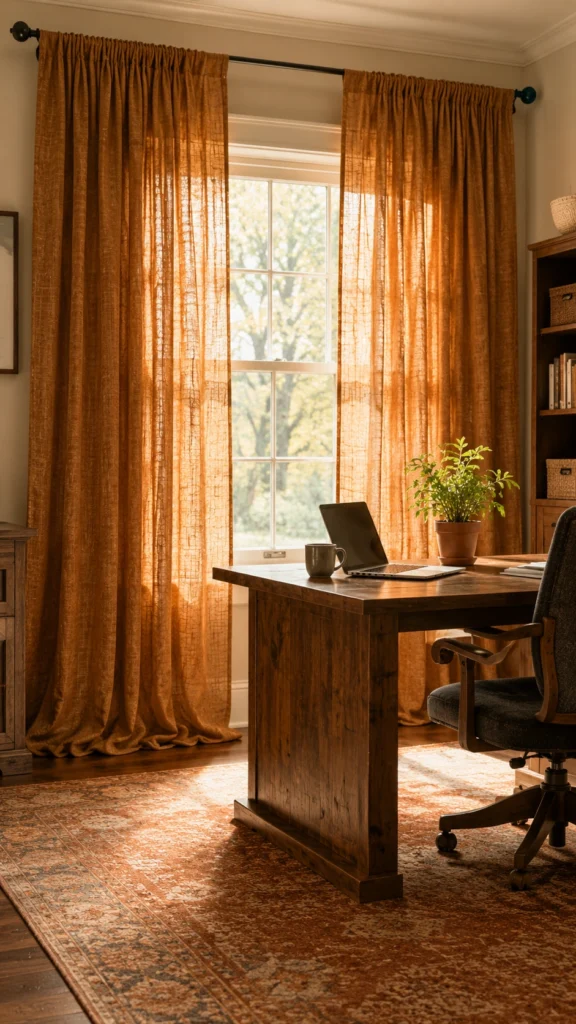
Curtains change a room faster than furniture does, and cost less to get wrong.
Caramel linen, olive, or deep rust in a heavier weight cuts drafts and softens harsh afternoon light in the same move. Hang the rod 4 to 6 inches above the window frame and let the panels reach the floor. Short curtains pull the ceiling down visually, which is the opposite of what a small office needs.
The mistake almost everyone makes is buying panels that are too narrow. You want 1.5 to 2 times the window width for proper fullness, which usually means two panels per window rather than one stretched flat.
8. Roll In a Tea and Coffee Cart Beside Your Desk
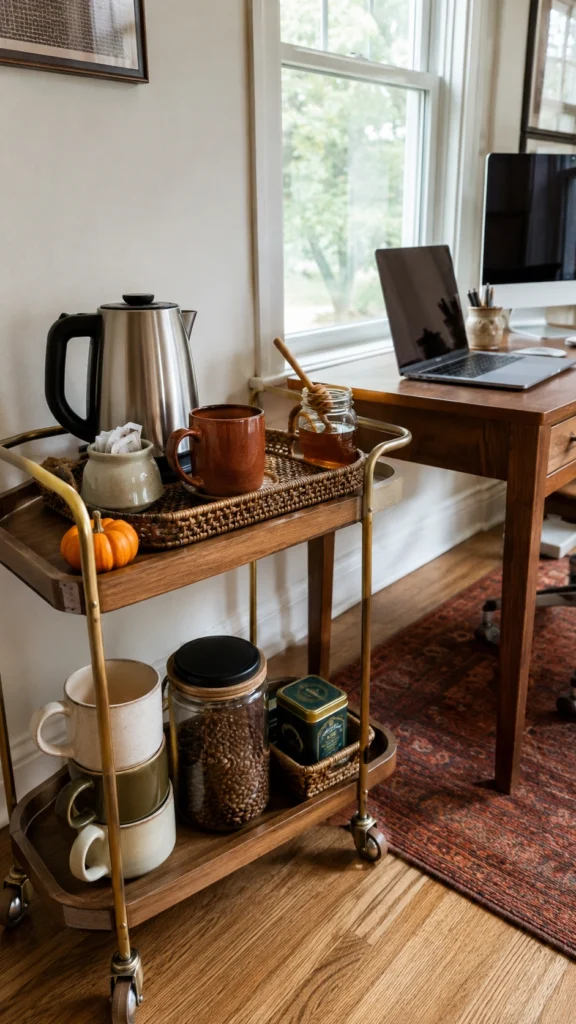
Every trip to the kitchen for a coffee costs about fifteen minutes, because you notice the dishwasher, then the post, then someone asks you something.
A two-tier rolling cart with your kettle, mugs, and tea tins ends that loop. Daily items on top, backups and spare mugs below. Add a small tray on the top shelf so the inevitable spill sits on the tray instead of soaking into the wood.
This one is worth it mainly if your focus disappears the moment you leave the room. If you already work in long uninterrupted stretches, skip it.
9. Trade Your Mousepad for a Cognac Leather Desk Mat
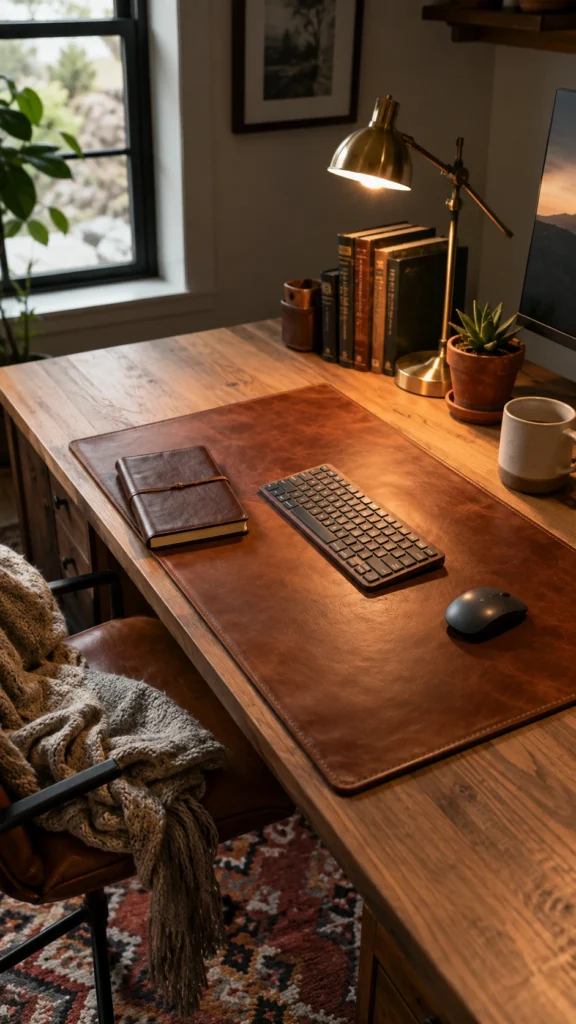
Scratched laminate is hard to hide and impossible to unsee. A large desk mat covers it for around $30 and pulls the whole surface together.
Go at least 31 x 15 inches so your keyboard, mouse, and a notebook all fit comfortably. Full-grain leather develops a patina and looks better in year three. PU leather usually starts peeling at the corners somewhere around year one or two, which is fine if you paid $15 and less fine if you paid $50.
10. Cluster Flameless Candles on a Wooden Tray
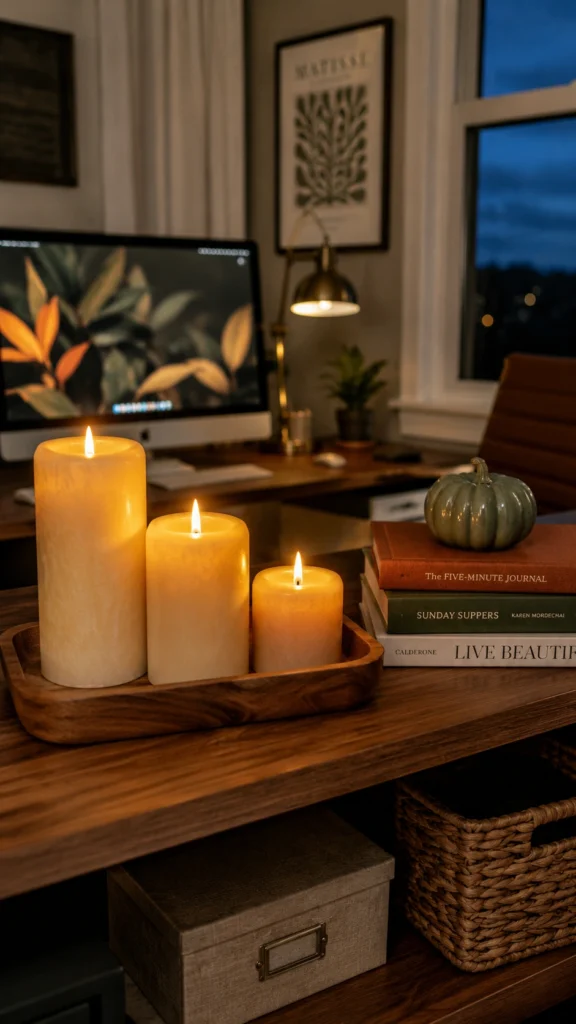
Open flame near paper stacks and charging cables is a bad idea in a room you’re only half paying attention to.
Battery pillar candles with a flicker mode give you the same glow, and the better ones have built-in timers that switch on at 5pm without any effort from you. Group three at different heights on a wooden or slate tray.
Colour temperature matters here too. Warm amber flicker reads as candlelight from across the room. Cool white LEDs read as a smoke detector.
Related Blog:
11. Frame Pressed Leaves for a Mini Gallery Wall
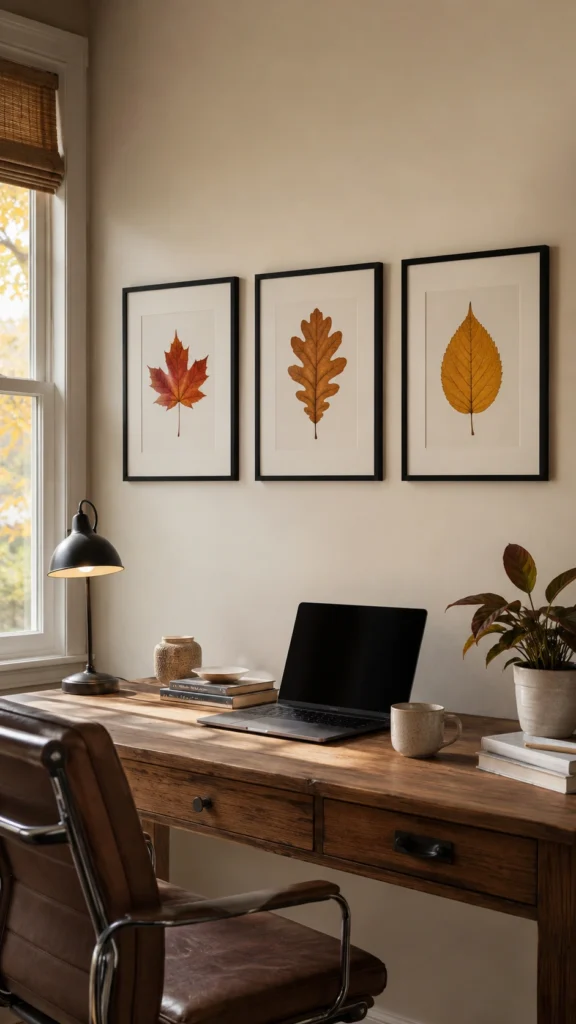
Press a few maple or oak leaves between the pages of a heavy book for two weeks, then frame them in thin black or oak frames. Three 8×10 frames above your desk cost under $40 and look like you spent considerably more.
Use white matting so each leaf has space around it. Edge-to-edge framing makes the whole thing look cramped, and it’s the single detail that separates this from a school project.
No decent leaves nearby? A page torn from a discount botanical calendar frames just as well. Nobody has ever asked about the source.
12. Hide Cables in a Woven Seagrass Basket
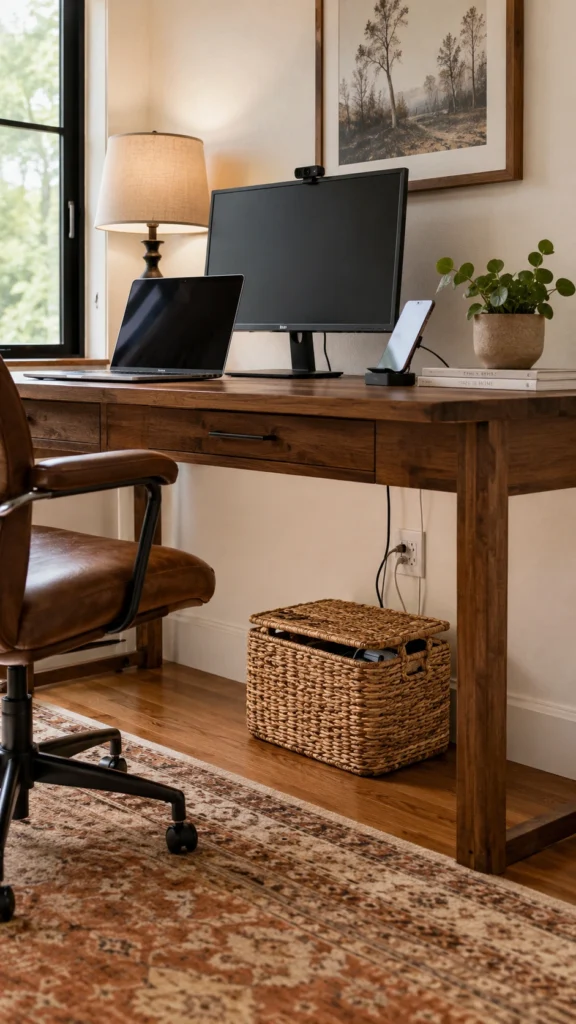
You can get the light right, the textures right, and the shelf styled perfectly, and a tangle of cables under the desk will still make the room look unfinished.
A lidded seagrass or rattan basket holds your power strip, chargers, and cord slack, and the woven texture sits well with warm autumn tones. Cut a small notch in the back rim so cables exit cleanly rather than propping the lid open.
Keep it on a hard floor rather than carpet if there’s a power brick inside that runs warm.
Related Blog:
13. Add a Corner Floor Lamp With a Fabric Shade
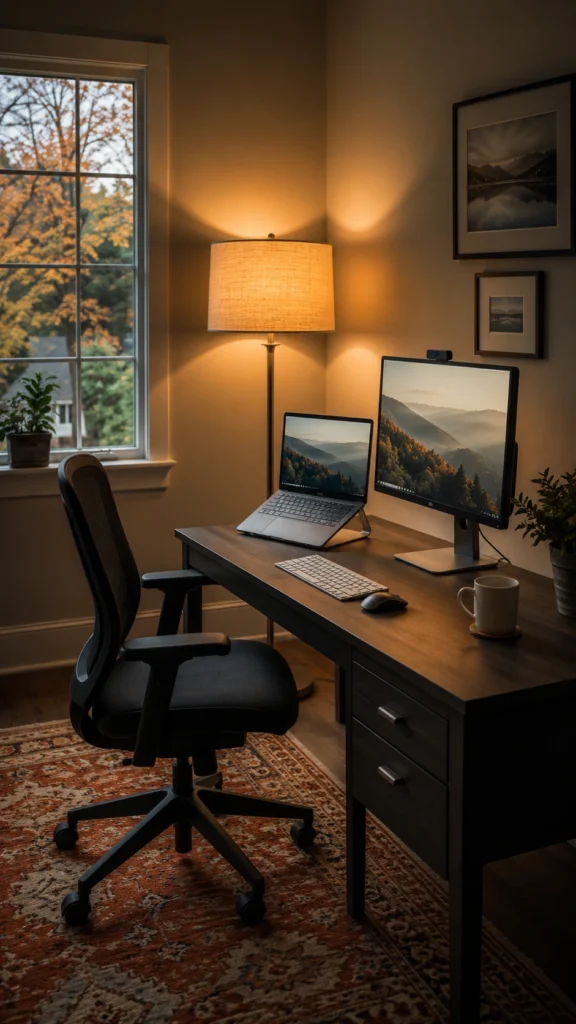
Overhead fixtures do two things badly. They throw glare onto your screen and they cast hard shadows down your face on video calls.
A floor lamp with a linen or fabric shade in the corner bounces light off the wall and evens everything out. Put it behind and slightly to the side of your monitor, not directly behind your chair, where it becomes a bright blob in the middle of your camera frame.
Rooms with one harsh ceiling light and nothing else benefit most from this.
14. Style Your Bookshelf With Earth-Tone Spines and a Small Lamp
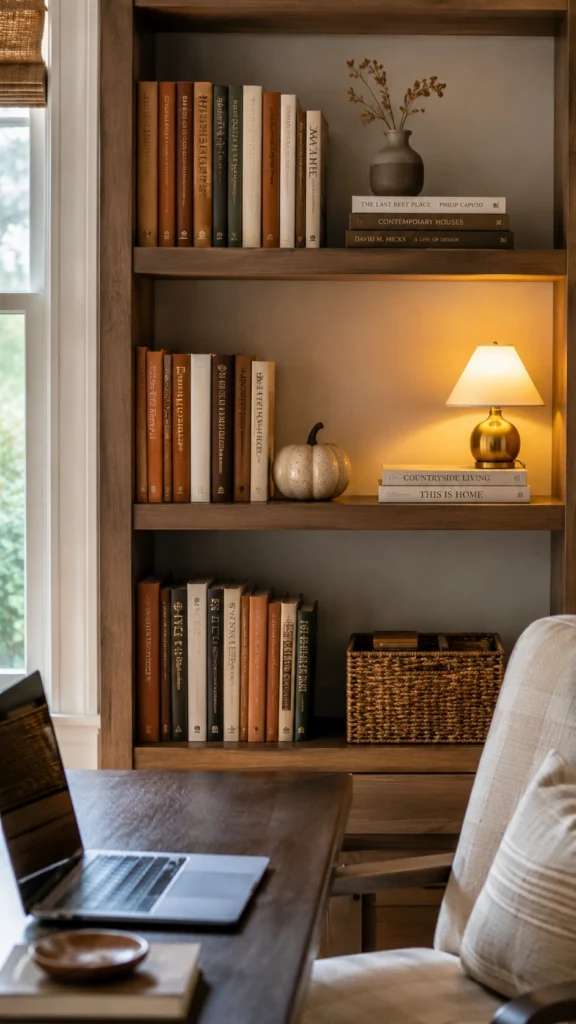
Pull every book forward until the spines line up with the shelf edge. Stack a few horizontally. Leave roughly 30% of each shelf empty.
That last part is what most people skip, and it’s why full shelves read as storage rather than decor. Add one small lamp or a short candle on the middle shelf so there’s depth instead of a flat wall of paper.
Earth-tone spines, a linen storage box, and a single dried stem keep it seasonal without turning the shelf into a display.
15. Cover a Corkboard in Linen for a Fall Mood Board
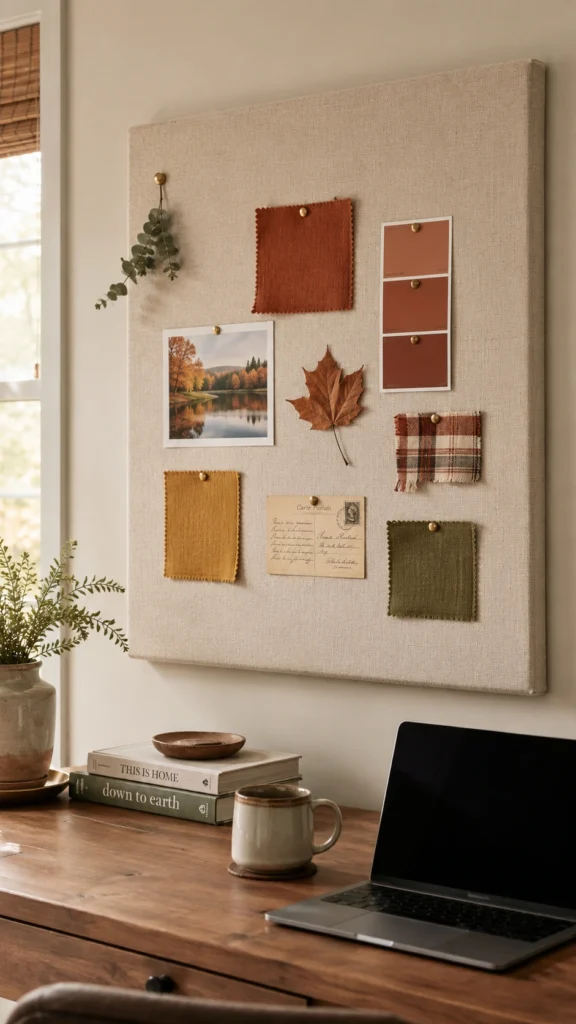
Stretch linen or burlap over a plain corkboard and staple it at the back. It takes ten minutes and turns a functional object into something you don’t mind having on the wall.
Pin fabric swatches, paint chips in clay and mustard, and printed photos instead of covering it in sticky notes. Cap yourself at four colours. Past that it stops reading as a mood board and starts reading as clutter.
16. Choose Plants That Tolerate Weak Autumn Light
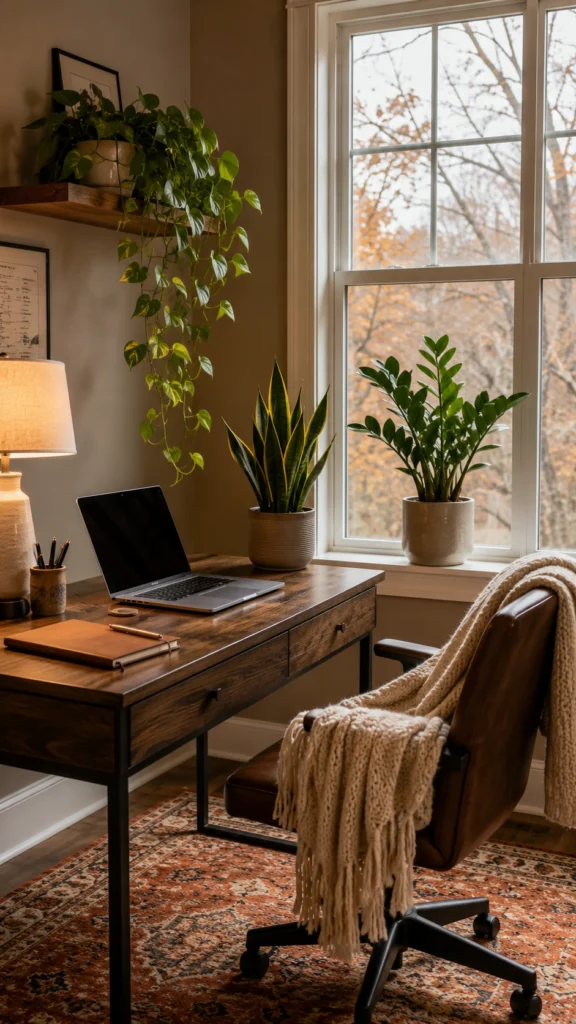
Daylight drops fast through October, and most desk plants start sulking by mid-November.
Snake plants, ZZ plants, and pothos handle low light and irregular watering. Fiddle leaf figs drop leaves the moment conditions shift, which makes them a poor pick for a room that loses two hours of sun over six weeks. Move whatever you have to within three feet of the window as the days shorten.
Adjust the watering as well. Slower growth means slower water use, so roughly half your summer schedule is a sensible starting point. Overwatering kills more office plants in autumn than low light does.
17. Put a Reed Diffuser in Cedar, Clove, or Fig
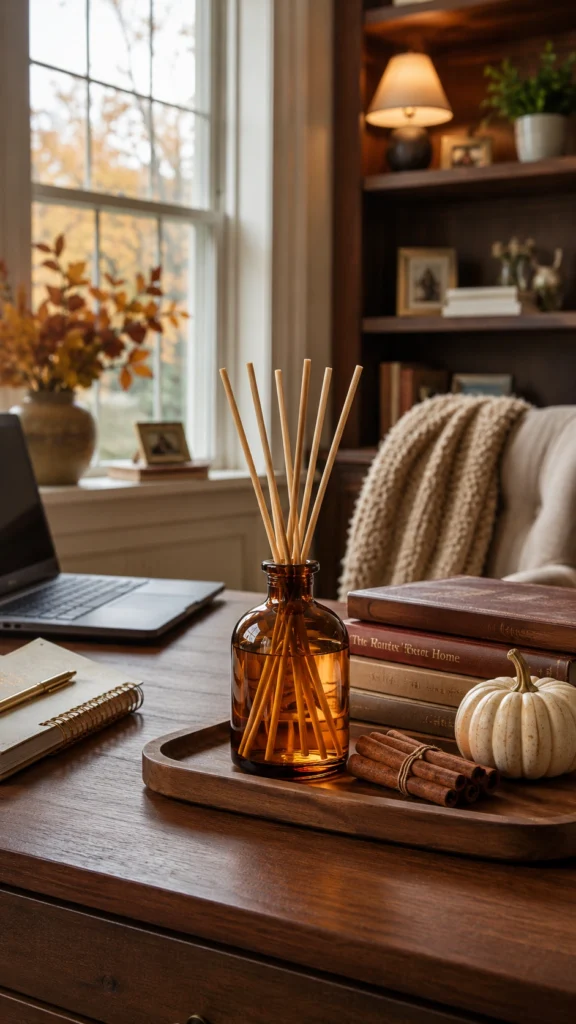
Scent affects how a room feels more than most people are willing to admit, and it’s the cheapest change on this list after bulbs.
Cedar, clove, fig, and smoked vanilla read as autumn without the bakery sweetness of every pumpkin spice product on the shelf. In a small office, a reed diffuser beats a candle, because you get steady low-level scent instead of a strong wave that fades to nothing by lunch.
Flip the reeds weekly, and keep the diffuser at least three feet from where you sit. Scent fatigue sets in quickly at close range.
18. Hang a Textile Panel Behind Your Video Call Chair
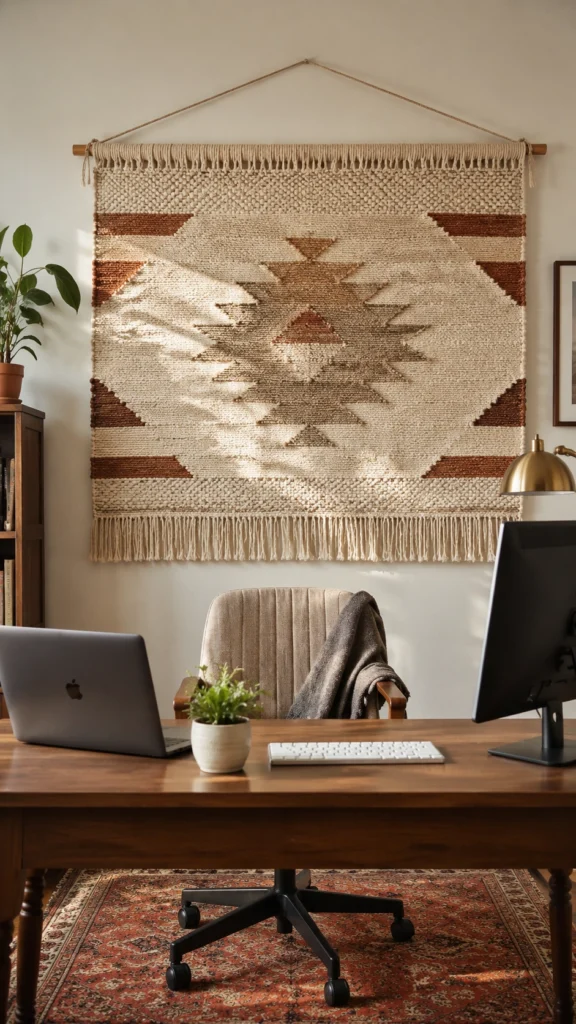
Your camera picks up whatever is behind you, which for most people is a blank wall or the chair where laundry lives.
A woven wall hanging or a hemmed linen panel in warm neutrals gives calls a finished backdrop. Hang it so it fills the upper two-thirds of your frame when you’re seated. Too high and it floats above your head like an afterthought.
Matte textiles work better than glossy prints here, since they don’t bounce light back into the lens.
19. Warm Up Your Tech With Wood and Brass Accessories
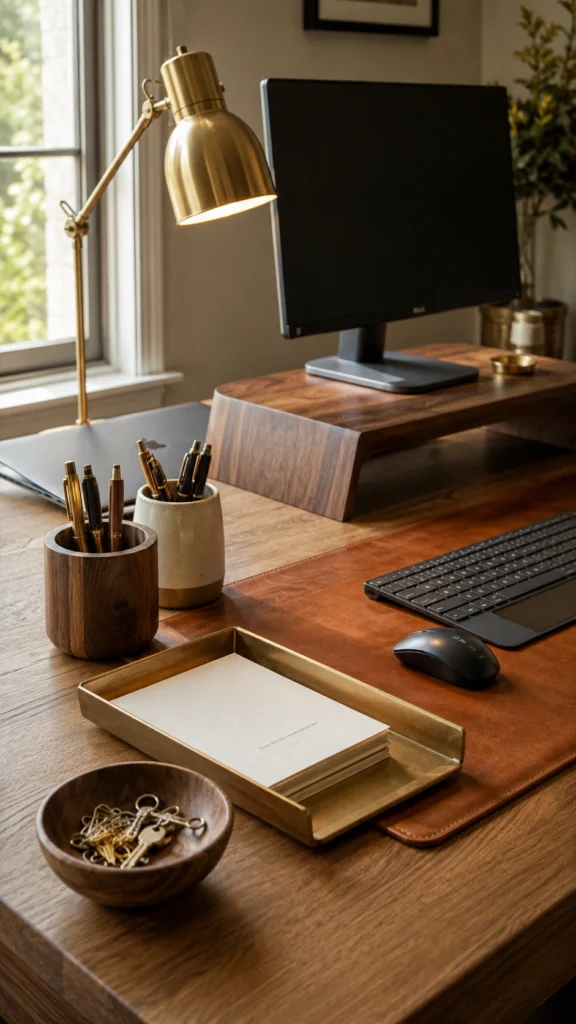
Black plastic organizers make a desk look like a supply cupboard, and most desks have three or four of them.
Swap the pen cup, monitor riser, and paper tray for oak, walnut, or brass and the tech quietly recedes. You don’t need a matching set. Two or three wooden pieces are enough to shift how the surface reads, and mixing finishes usually looks better than a coordinated kit anyway.
A plain wooden bowl holds clips and keys perfectly well, and a thick cutting board makes a solid monitor riser. Both cost a fraction of anything sold as a “desk organizer.”
Related Blog:
20. Add a Small Amber Glass Task Lamp
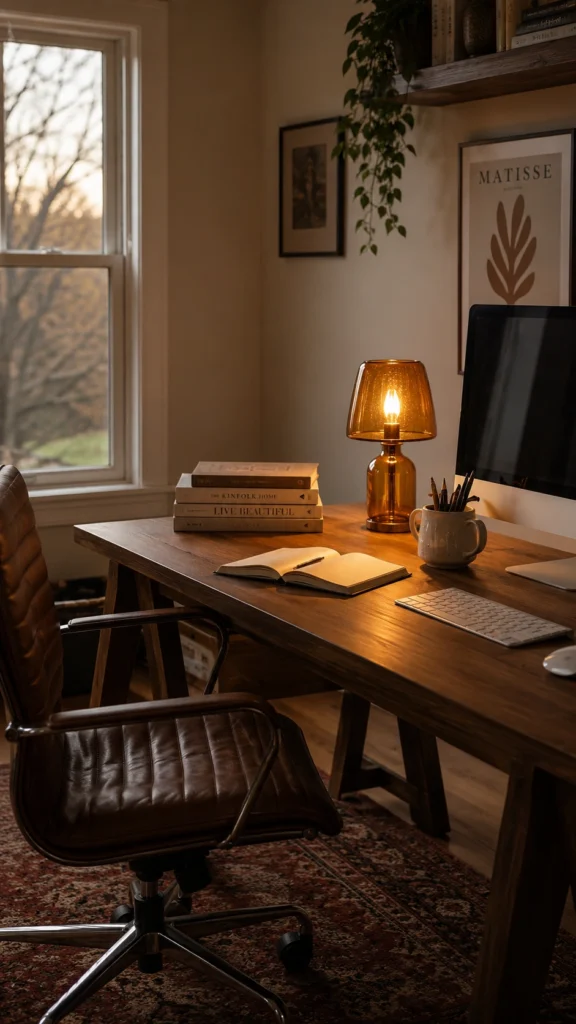
Amber and smoked glass have a useful quality: they add warm colour to the desk even when the lamp is switched off, which is most of the morning.
Position it on the opposite side from your writing hand so the shadow falls away from your work. Pair it with a lower-wattage bulb, around a 40W equivalent, because a task lamp should support your room light rather than compete with it.
For desks pushed against a wall with no room for a floor lamp, this is the practical substitute.
21. Cut Afternoon Glare With a Layered Sheer
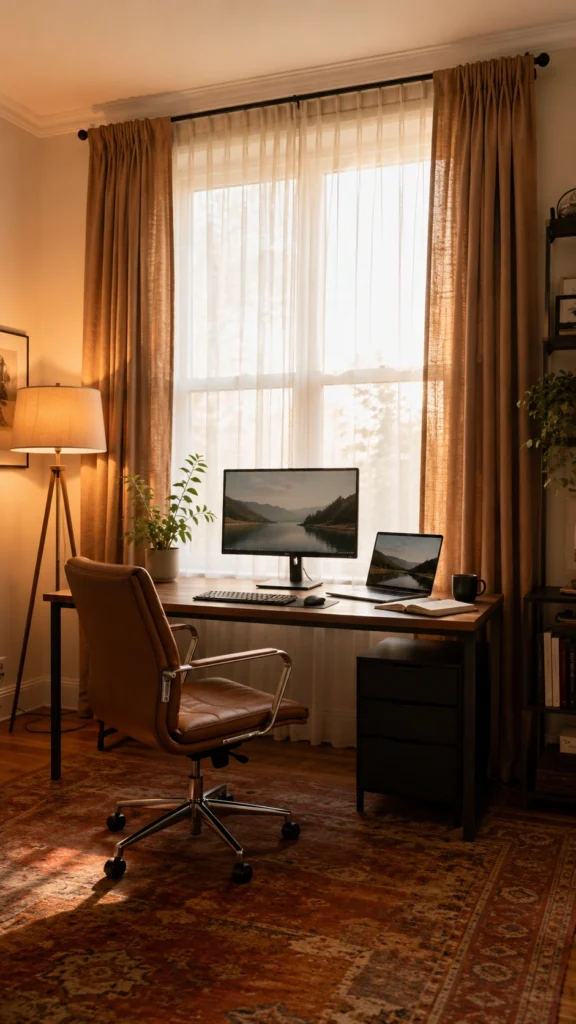
Low autumn sun sits at exactly the wrong angle for screens, usually between 3 and 5pm, and usually right when you’re trying to finish something.
A sheer layered behind your main curtain diffuses the worst of it while keeping the room bright. Frosted window film does a similar job for about $15 a roll, with one catch: it stays up year-round, so use it on a window you don’t rely on for the view.
What doesn’t work is shutting the blinds completely at 3pm and then wondering why the room feels like a basement an hour later.
22. Carve Out a Shutdown Nook With an Armchair and Side Table
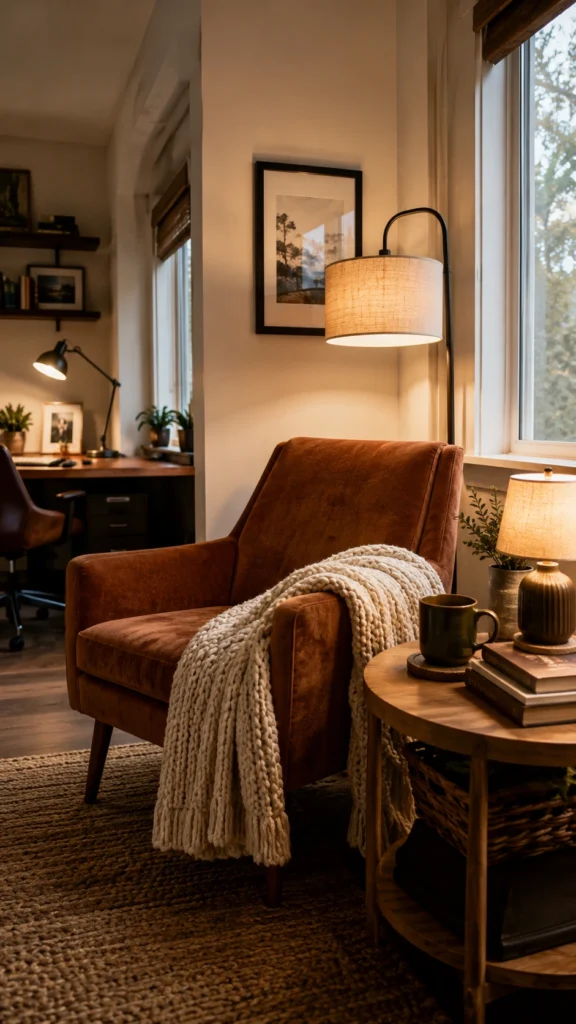
Working where you live blurs the end of the day, and no amount of scheduling fixes that as reliably as physically moving somewhere else.
A chair in the corner with a small side table gives you a place to sit that isn’t your desk. A compact accent chair, a floor lamp, and a stack of books fit into roughly a 3×3 foot corner, so this is more achievable in a small room than people assume.
Worth doing if your workday currently ends when your laptop battery does.
Related Blog:
How to Put These Fall Home Office Decor Ideas Together
Doing all 22 at once turns a calm room into a craft fair. Work in layers instead and you’ll spend less money for a better result.
Start With Light
Light does the heaviest lifting in any fall home office decor plan. Bulbs first, corner lamp second, window glare third. Most people notice the change within a day, and none of it requires moving a single piece of furniture.
Add Texture Second
Once the light is right, bring in the rug, throw, seat pad, and curtains. Texture is the difference between a room that feels warm and a room that only photographs that way. Three textures in one space is usually the sweet spot: something woven, something knit, something wooden. Four or five starts to look busy in a room the size of most home offices.
Save Seasonal Accents for Last
Pumpkins, dried stems, and pressed leaves go in at the end, once everything else has settled. They’re also the pieces you’ll swap in January, so keeping the count low saves you work later. Five or six seasonal objects is plenty for an average-sized office, and I’d argue three well-placed ones beat eight scattered around.
Keep Your Fall Home Office Decor Budget Realistic
Most of this list is achievable for under $150 if you prioritize. Bulbs, a throw, dried stems, and a desk mat come to roughly $70 and change the room noticeably. Curtains and an accent chair sit in a different tier, so treat them as upgrades rather than the starting point.
- Under $50: bulbs, dried stems, flameless candles, cable basket
- $50 to $150: rug, throw, desk mat, task lamp, seat pad
- $150 and up: curtains, floor lamp, accent chair, rolling cart
Recommended Blogs
- 15 Fall Candle Decor Ideas
- 24 Fall Coffee Table Decor Ideas
- 20 Fall Decor Ideas for Bedroom
- 22 Cozy Small Apartment Decorating Ideas
- 24 Small Apartment Organization Hacks
Final Thoughts
The best version of this list isn’t all 22 items. Warm bulbs, one soft textile, and a small seasonal grouping already shift how a room feels, and together they take an afternoon.
Pick the ideas that solve something that actually bothers you. Cold feet, screen glare, calls that echo, cables everywhere. Fix the irritations first and the cozy part arrives on its own, because most of what makes a room feel unpleasant in autumn is practical rather than decorative.
Start with the bulbs this weekend. You’ll know within an evening whether the room needed more, and $15 is a cheap way to find out.
FREQUENTLY ASKED QUESTIONS
What colors work best for fall home office decor?
Rust, ochre, olive, caramel, and warm clay give you autumn warmth without tipping into holiday territory. Ground them with oatmeal, cream, or natural wood so the room still works in February. Two or three items in bold seasonal colour is usually enough, with texture carrying the rest.
How do I make my home office cozy without losing productivity?
Choose comfort that supports the work. Warm light, a rug to cut echo, and a throw for cold afternoons all help. Anything that blocks your chair’s lumbar support, crowds your desk surface, or sits between you and your monitor will cost you more than it gives back.
Can I decorate a small home office for fall without making it feel cramped?
Yes, as long as you build upward and keep surfaces clear. Wall space handles framed leaves or a textile panel, a floating shelf holds your seasonal grouping, and a lidded basket takes care of cables. Vertical decor adds warmth without eating desk or floor space, which is the whole trick in a small room.
What’s the cheapest way to make a home office feel warmer in fall?
Change the bulbs. A four-pack of 2700K LEDs runs under $15 and shifts the mood of the room in about ten minutes. Add a $25 knit throw and a $10 bunch of dried wheat and you’ve covered the essentials for roughly $50.
How long should fall decor stay up in a home office?
Late September through November is typical, then the pumpkins and leaves get swapped for winter greenery. Keep the base layers, meaning your rug, curtains, lamps, and desk mat, in place all year. Choose those in neutral warm tones, and each seasonal change comes down to four or five small objects.